Comments
Ideally, they wouldn't fully retire until their health declined to a point where full retirement was advisible.
I say that based on the experience of (US) federal judges. Although I'm simplifing, many could retire at 65 with full salary for life. But retirement is uncommon. Instead, judges take "senior status" which allows them to select their own caseload volume. [1] This allows their old seat to open up for a new appointee. Being at 100% until one's early 80s certainly happens, while I'd say being at 50% at that point is fairly common.
What I discern from this is that if people in their 60s, 70s, and even 80s are provided with the opportunity to do work they find impactful and enjoyable, and to scale the volume of that work downward as they age, most of them prefer to keep working in a part-time capacity. And although I don't have data to back this up, [2] I think most senior-status judges are happier than they would be on full retirement. That could be even more true for EAs; after a career focused on impact, spending all one's time hitting the beach could feel . . . empty?
On the what's good for EA side: senior-status judges do a significant fraction of all federal judicial work. Where mostly remote work is available, they are particularly useful at filling in when a court is short-staffed (due to delays in getting enough judges appointed and confirmed) or when there is enough work for (say) 1.2 judgeships in a court. I think those kinds of benefits could transfer to other contexts.
So all that is to suggest that a "Senior-Status EA" program could be a valuable way to tap into experienced retirement-age talent that would make the retirees happy.
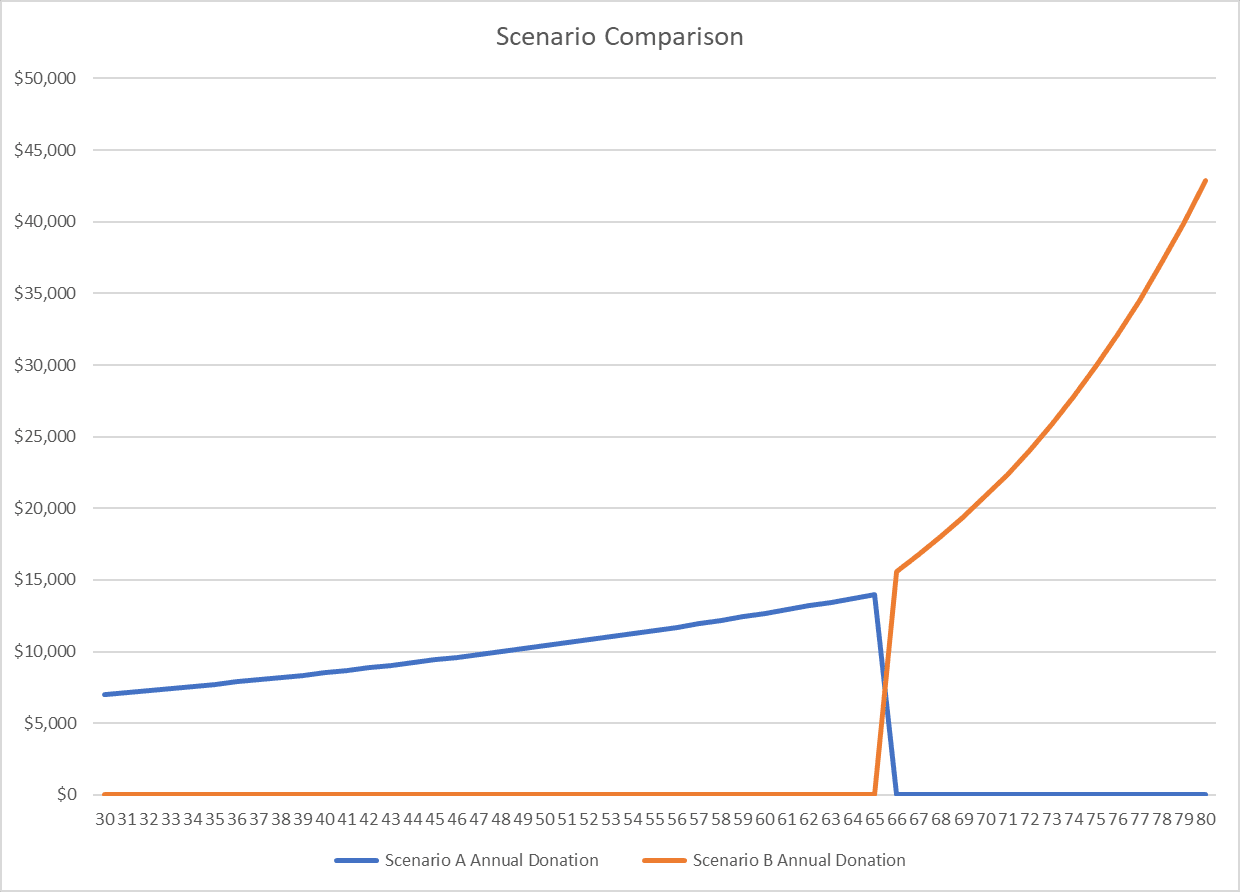
Personally, I currently plan on never retiring prior to the singularity: I'd just keep working. Well after the singularity, I'm not confident, but it seems hard to plan.
Note: actually retiring is pretty cheap, so if commiting to that is useful for motivation, it should be a good idea even putting aside self interest. Personally, I find the idea of trying to do my best even when I don't have much to give motivating, at least aspirationally, so I'm planning on doing this.
If (prior to the singularity) I end up in a state where I'm unable to contribute value higher than my cost of living, I'll probably just do voluntary euthanasia? This is predicated on quite strong longtermist views where current lives aren't very important. But, maybe it makes sense to instead just move to a place with a very low cost of living and try to live very cheaply (e.g., on a few dollars a day or something) while being as happy as possible?
That said, my understanding is that in the US in the current policy regime, it would be good to stay alive to collect social security to donate (e.g., this value is higher than my cost of living particular when optimizing the cost of living down).
I'm not confident I'll remain this fanatically non-self-interested on further reflection, but this my median guess for what my future views would look like after thinking about it for the rest of my life.