Comments
Love this post. In particular, I'd be keen for much closer collaboration on hiring!
Love this post. In particular, I'd be keen for much closer collaboration on hiring!
Can someone tell me the author of this document here, called EA Common Application?
It's me, Vaidehi (have edited the doc to reflect that)
I completely agree, I've thought this ever since I joined the EA movement in 2013, and think this space (among others) is exceptionally neglected.
Some public examples of work I've done in this space include thinking about how to improve funder, project, and volunteer/team coordination as well as providing specialized services to the community. Given that this is a neglected area with little time and money available for people to make progress on it, I think it's no surprise that the space has "a large 'graveyard' of untried proposals or projects." I think the presence of such a graveyard is fairly indisputable, and with the current way coordination is done in the community, the only path forward appears to be greater advocacy for this area to receive more time and resources and/or improving coordination specifically among people that see this as a gap, both in terms of idea sharing and collaboration, and in terms of securing funding.
I continue to be interested in this area, and anyone who's interested in potentially collaborating is welcome to get in touch!
Always nice to have a strong feeling about something and have your argument confirmed and strengthened by others.
I would say, there's a lot of work to do in this space. I am happy to hear about the 2 recent CE charities pointing in this direction, and many more are needed.
One thing I would note here, I suspect that non-scalable solutions (e.g. headhunting) might not be able to keep up with demand in the foreseeable future. This would be because community building is particularly tractable, and the current level of efforts and money being put into community building could mean that it could grow faster than other parts of EA. The end result would that the types of infrastructure discussed above would continue to be out of reach for the majority of EA's on the local level.
For this reason I suspect that local groups will have to build a lot of the services discussed here (skills training/headhunting/career planning) for themselves. Therefore I think we are locked into a trajectory of EA being a movement where most activity (research/learning/networking/jobs) exists in local groups, something most EA's would find unimaginable at the moment.
Thanks for this post. Here are some links discussing some related things, which I therefore thought might be of interest to the authors or to readers:
As this is (probably) central to coordination: is there something like a clear decisionmaking structure to decide what "the community" actually wants (i.e., what is "ursuing EA goals", concretely, in a given situation if there are trade-offs)? Is there an overview/explanation of this structure?
There are at least ~70 EA-aligned or adjacent organisations (including national/local/university groups)
Did you mean to say not including national/local/university groups? There are about 300 national/local/university groups (according to Ben West at CEA), and I would guess ~70 is about the number of orgs which identify as EA-aligned.
Good catch, Gina! :) Yes, it's supposed to be "not including". I've changed it now.


Coordination problems in EA seem somewhat pressing, but we are lacking a structured way to think through different kinds of coordination challenges and bottlenecks.
In this post we
Our intention with this post is mainly to open up a discussion about this topic so that everyone can contribute to it and understand it better.
The importance of coordination & coordination challenges has been periodically discussed for several years in the EA movement. In recent years, it seems that these challenges are becoming more acute - in November 2020 Benjamin Todd mentioned that currently, “the main bottlenecks might be organizational capacity, infrastructure, and management to help train people up, as well as specialist skills that people can put to work now”. (80,000 Hours episode). Under the assumption that these are the current bottlenecks of the community, coordination should help alleviate the effects of these bottlenecks.
The EA community is fairly highly collaborative and seems to focus on coordination more than other social movements. As such it does not appear that a lack of coordination related to building capacity and infrastructure has been the cause of negative outcomes (there are risks associated with info hazards or the unilateralist’s curse where a lack of coordination can be negative). Nevertheless, it seems that improving coordination would allow our community to do even more good. We think that there is significant room for improvement to build systems, or infrastructure, that could enable better coordination within the next 3-5 years and we would expect them (given the current trajectory of the community) to pay off for > 5 years after they’ve been refined.
In this post, we aim to map the meta landscape of internal coordination bottlenecks within the community. We hope this is useful for those thinking of or currently working in this space.
While we believe there are also significant opportunities to improve or develop coordination between EA and the communities adjacent to EA (“the outside world”), this post will focus more on internal coordination issues.
Note: “Organizations” refer to those which actively engage with the EA community, regardless of identification as EA-aligned or not.
We have identified two kinds of cross-cutting coordination services that existing and potential future services can be categorized into.
Services which eliminate avoidable, non-programmatic* (not unique to an organisation’s specific mission or area of focus) barriers for organisations & projects, to encourage experimentation and innovation and to free up people to spend more of their time on problems that they have a comparative advantage to solve.
There are at least ~70 EA-aligned or adjacent organisations (not including national/local/university groups) and probably hundreds of individuals pursuing EA projects. This number is growing. They can face a number of coordination inefficiencies.
Based on initial research, there seems to be great room for improvement around knowledge generation and knowledge sharing for nonprofit management among EA organisations. Particularly operations management and nonprofit operations research within EA could potentially be greatly improved through solutions such as operations consultancies, agencies or think tanks that work closely with EA organisations. Other promising areas include: nonprofit strategy, country selection, legal services, practical decision-making under uncertainty, i.a* (This research is currently being undertaken by Cristina for early stage nonprofits with the guidance of Charity Entrepreneurship.)
Many ecosystem bottlenecks appear to be related to the allocation of talent. Although we think in general that too much emphasis is sometimes placed on jobs at EA-aligned organisations, we think that there is also room for improvement that could create a better environment for job-seekers and recruiters. Specific issues for some EA organisations include:
There are also challenges for candidates such as:
Some targeted solutions for these challenges, which avoids unintended consequences could be:
Expanding existing opportunities and growing the professional EA community. This could include ramping up successful programs or organisations or skilling up potential managers so that we can effectively absorb new talent.
White-label community infrastructure services for sub- and adjacent communities (e.g. profession and cause groups). These can benefit from economies of scale and will save individual groups a lot of resources. These can include things like high-quality directories and forums.
Services which ensure that EA is a sustainable and healthy community where anyone who wants to and is able to contribute has access to relevant information, networks & opportunities without facing significant non-essential barriers (which could result in them sacrificing a significant amount of time, mental health and wellbeing, or other resources) in pursuit of those goals.
The EA community appears to be steadily growing during the last years and it makes sense to centralize some services to provide them at a low-cost to the entire EA ecosystem.
It is plausible that many people trying to switch to more impactful career paths are not pursuing their optimal opportunities, and there are ways to improve this allocation of talent so that they and the community can benefit from the career capital (connections, experience, credentials & skills) that they will gain.
There are 3 main benefits to this:
This will achieve two things: 1) increase the number of people pursuing careers outside the movement, and 2) increase the likelihood they will succeed in those careers.
Having people working to improve allocation of talent outside of the EA community including professional communities / networks & developing more robust cause area subcommunities could help increase the number of well-defined impactful roles (through sharing information on promising opportunities), as well as the pathways to enter them (through inside information, referrals & networking).
For more on this, see Focusing on Career & Cause Movement Building and Ecosystems vs Projects in EA Movement Building.
Educational programming / outreach
Assess common communication failures and the accessibility of information to community members
Preventing missed opportunities
This work is currently done by Rethink Priorities (e.g. the EA Survey). This could be supplemented by longitudinal surveys, although we find this area less tractable as gathering community data has been challenging in the past. Our current understanding is that the research itself may be time-intensive, but finding subjects to interview is possible.
With more data we can:
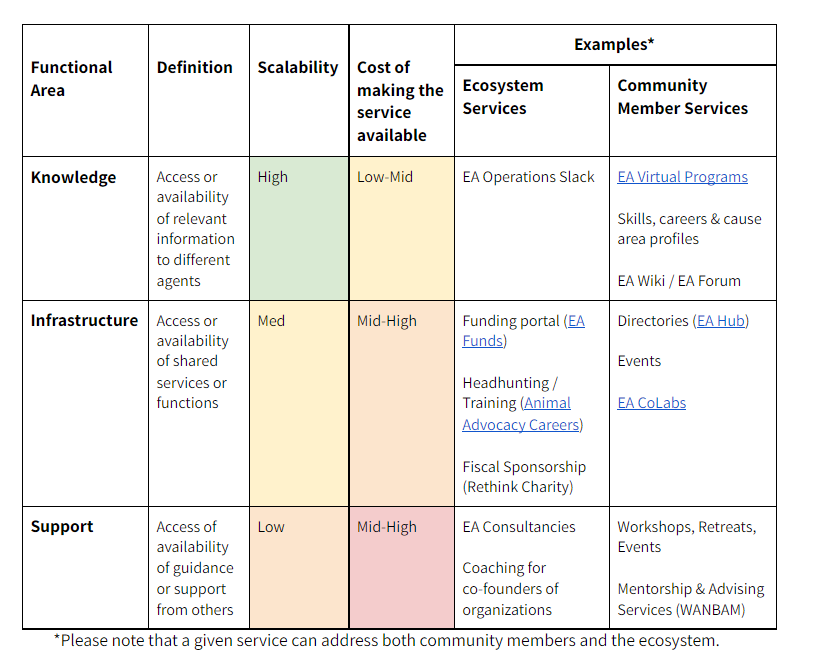
There are three main functional areas that we’ve identified related to coordination bottlenecks - for which services can be offered. We think it’s useful to identify these to understand the goals each may serve. In practice, we expect that many bottlenecks and relevant interventions will cover multiple functional areas.
The following table summarizes some aspects & a few examples of different functional areas.
If you know of other services that have helped improve the coordination of the community, please let us know in the comments. We’ll keep updating this post accordingly.
Are there other types of improvements we haven’t considered with this post that you’d like to highlight? We’d be excited to learn about them.
Very grateful for this post. Personalizing to contextualize, it's amazing to see Vaidehi, Christina, Jack (and others I apologize for not remembering/knowing about) for consistently advocating for things that I gave up pursuing after hitting brick walls for years in the community starting in 2015. It takes courage (and almost certainly, tact) that I didn't have at the time when I was running multiple projects in this space. Maybe someday I'll say more about that if people would be interested
On the 'coaching for co-founders of organizations', Training For Good is exploring this area with their coaching trials (which I'm a part of), and in general this is something I feel well-positioned to tackle and I'm currently looking for support in being able to do so. I've recently finished trialing my coaching with more than a dozen EA leaders over the last few months. I feel the results are quite good, but I'm debating whether to post them publicly for privacy reasons. People who may be interested viewing the results can DM me! Keen to chat with anyone who wants to talk about supporting EA leadership
Thank you Tee! I'd be interested to learn more about the results. I sent you a message.