Comments
In this piece, I examine the objections to the following, deemed by EA Animal Advocacy to be ineffective. I think that, in all of these cases, the evidence that these strategies are ineffective is quite weak.
- Influencing social & political opinion.
- Individual outreach.
- Advocating for elimination (of animal-product consumption) rather than reduction.
- Advocating using an animal-centric message (rather than broad appeal, ‘safer’ messages like health, environment or taste).
Preface
This post is part of series: Abolitionist in the Streets, Pragmatist in the Sheets: New Ideas for Effective Animal Advocacy. The series' main point is to point out that (broadly speaking) animal advocacy within Effective Altruism is uniform in its welfarist thinking and approach, and that it has assumed with insufficient reason that all abolitionist thinking and approaches are ineffective.
I (a pragmatic, abolitionist-leaning animal advocate and vegan) wrote this series voluntarily, in rare spare time, over the course of 14 months, with help from three other vegans, all of whom have been familiar with EA for a few years. It is intended to be a big-picture piece, surfacing and investigating common beliefs within EA animal advocacy. Necessarily, I deal with generalisations of views, which will not cover all variations, organisations, or advocates.
Introduction
Effective Altruism is dominated by people who subscribe to utilitarianism, and so given that welfarist interventions are easier to argue as increasing utility than abolitionist interventions, their approaches to animal advocacy tend to be dominated by welfarist thinking. Note that this does not mean abolitionist interventions are incompatible with utilitarianism, it just means that measuring their effectiveness has to be creative and appropriate (see Social Change Dynamics).
Measurability is not the only approach on the table though: hit-based approaches are also a valid strategy (more frequently used in longtermist cause areas). However, hits-based abolitionist approaches require some intuition/belief that an abolitionist idea could work. To my (perhaps naive) surprise, discussions with animal advocates at EA Global London 2022 or Charity Entrepreneurship social evenings, there was near-universal dismissal of calls to investigate the ideas in this post (cultural advocacy in LMICs, the value and best strategies of smart outreach, farmer transition policies). Nearly all simply thought these ideas were not worth investigating, but when asked for reasons why (I actively proposed these ideas to get feedback for this post), I either did not get any, or got politely intuition jousted. Of course, my experience is just that, and may not be reflective of EA as a whole. But if it is, I believe the current situation has led EAs to ignore possibly effective tactics and to under-research certain promising approaches to animal advocacy.
I’ve already discussed the three types of approaches EA Animal Advocacy deems to be effective. In this piece, we examine the objections to the following, deemed to be ineffective.
- Influencing social & political opinion.
- Individual outreach.
- Advocating for elimination (of animal-product consumption) rather than reduction.
- Advocating using an animal-centric message (rather than broad appeal, ‘safer’ messages like health, environment or taste).
I think that, in all of these cases, the evidence that these strategies are ineffective is at best weak.
Influencing Social & Political Opinion
Sentience Institute Report
Strategies which seek to influence social/political opinion are deemed ineffective (when it comes to animal advocacy, but not for longtermism), based on studies of other issues as mentioned in this Sentience Institute report.
As far as I understand, the report is intended to answer the question ‘Is influencing social/political opinion a worthwhile goal in general, and what makes it work or fail?’ rather than ‘Is influencing social/political opinion a worthwhile goal for animal advocates?’. As such, I do not wish to say the report argues one way or another, or criticise it for not doing so. What I am doing is merely pointing out three ways in which applying the report’s findings to animal advocacy is premature.
- We do not know the cost-effectiveness of the interventions studied. Perhaps the effect size is small, but the relatively scalable nature of some methods still make it worthwhile.
- We do not know whether the evidence and conclusions apply to the issue of animal advocacy, which is different in many important respects.
- The strategies used for other issues are not the only ones used by abolitionist animal advocates, and can differ significantly.
I expand on the latter two points below.
Animal advocacy is different from other issues in a number of ways. Animals cannot speak for themselves, cannot tell their own stories. Animals are relevant to all humans. Eliminating animal agriculture has multiple benefits for humans (pollution reduction, soil erosion, climate change, pandemic risk reduction, antibiotic resistance reduction, and health benefits) and so advocates have self-interest across multiple issues as an additional line of attack. Compared to other topics, the case for eliminating animal agriculture is simple and clear. Finally, as I discuss in the next section on individual outreach, animal advocacy is a uniquely economic moral emergency. It’s not clear to me whether the sum of these differences makes influencing social/political opinion on animal agriculture more or less difficult, hence I wish to see more research around this specifically.
When it comes to strategies themselves, the report says “Many of these effects come from studies using only short messages in artificial contexts, so they may not be very informative about the effects we should expect from real-world advocacy contexts. More extensive interactions (e.g. a lengthy conversation, a documentary, a book) or repeated exposure to similar arguments (e.g. via shifts in media coverage, discussed below) may have larger effects.” This points to a significant problem of ‘basketballism’ (the parable from this post), where the interventions that are studied happen over too short a time scale to make changes. Abolitionists tend to focus on long-term behavioural change that requires ‘deep’ discussions, which are difficult to study (streetlight effect).
The report does consider this issue extremely briefly, by comparison with health behaviour interventions, saying they “tend to have small or very small effect sizes”, based on studies using “more realistic interventions, such as lessons conducted over a number of weeks in schools or large-scale mass media campaigns visible to the general public”.
Again, the issue here is that this is not a like-for-like comparison of strategies. Effects of health behaviour interventions are more likely to be independent rather interdependent (see Social Change Dynamics). Furthermore, ‘deep canvassing’ is much closer to the actual strategies of abolitionist campaigners (from local ones, to more famous ones like Earthling Ed) than the limited, ‘surface’ outreach that the report discusses, and there does exist limited evidence for it. This suggests that in-depth, focussed, respectful discussions really can change minds, at least some of the time and under certain conditions (most studied in the context of trans rights outreach). In other words: the research that EA draws upon to dismiss abolitionist approaches doesn’t actually take seriously the way abolitionists campaign (see also this post).
Protests and Disruptive Actions
Another major topic when it comes to social/political opinion is direct action and protests. Opinions differ on this, since measuring the effectiveness of such actions is difficult. A recent (2022) Faunalytics report weakly recommends against protest, arguing the effect on people’s behaviour is negative at worst, and neutral at best. It tempers this recommendation by adding that they only looked at “two studies, of which one used self-reported data and the other relied upon exploratory analyses” and called for replication/additional research. In contrast, this report argues that XR protests in the UK were effective using a ‘many weak pieces of evidence’ approach, and the same authors in a different piece, provide suggestions on what factors make a protest more effective.
Both reports agree that protests are more effective when the majority agrees with the cause, but seem to say little about how (if not with raising awareness through such actions) a society gets to that point.
Disruptive actions are rarely discussed and easily dismissed, due to concerns about the backfire effect (which is also a commonly held fear about protests or outreach). We note here that the ‘backfire effect’ has had trouble being replicated, and needs more robust evidence to deny or confirm it. On the contrary, there is reasonable research that indicates “a nonviolent radical flank is likely to help, not hinder, a social movement”. Such actions are difficult to evaluate in terms of effectiveness: an evaluation would have all the complexities associated with evaluating the effectiveness of protests, and additionally the need to take into account rises in the costs of production, because of increases in insurance premiums and security costs.
It is entirely possible that protests and direct action fit better in a hits-based approach rather than a measurement based one. With this model, the emphasis wouldn’t be on the specifics such as messaging, inclusivity, degree of disruption but merely on scale/number of attendees and the media amplification of the intended messages. In 2019 in the UK, more than 12,000 people attended an animal rights march, which attracted some media attention, compared to 2021 and 2022 at which turnout was much smaller (not advertised by EA organisations) and did not attract media attention. By this metric, small scale disruptive protests which make the news and enable a few minutes of airtime of key talking points (and increasingly, fair or sympathetic ways) could be far more cost-effective.
Social Change Dynamics
This part is based on section 6 in Harrison Nathan’s 2016 essay; which is worth reading for its discussion of “foot-in-the-door” vs “door-in-the-face” request techniques, descriptive vs injunctive norms, and independent vs interdependent actions.
(Nathan also notes ACE’s omission of extant literature or experts on the subject, which led me to check whether there were any such omissions from the SI report: Whilst SI has discussed its methodology, and how and why it differs, I did not find any reference to the theory of interdependent behaviours or social change dynamics.[1] Nor did I find any reference to the books[2] Nathan mentioned on the aforementioned links, or their public opinion report.)
My contributions here are drawing out the implications of this on (1) the theory of change for and (2) measurement. But before that, I need to briefly explain independent vs interdependent actions. An independent action (the example used is better nutrition) has a close (linear) correlation between attitude and behaviour. An interdependent action (the example used is community toilet usage) is one which is non-linearly (symmetric sigmoidally)[3] correlated. The illustrative figures below are from What are social norms? How are they measured? (Mackie et. al, 2015).
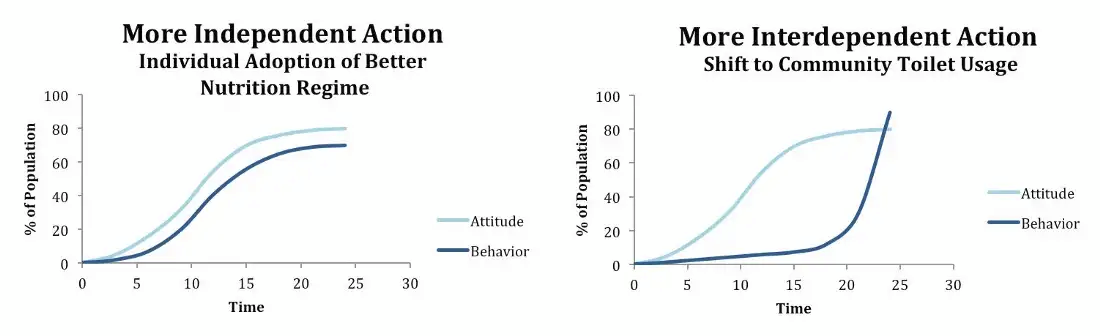
It is also worth noting that this is not a purely theoretical/untestable claim. In the graph for interdependent action, behaviour starts to change rapidly when around 80% of the population has been convinced. However, experimental evidence suggests ‘tipping points’ for social change could be as low as 25%. More research and replication on this would be extremely useful - for example, how does the difficulty of making a change moderate the size of the tipping point?
The theory of change here is that it is not (just) increasing the number of vegans, or improving welfare, that will bring about abolition, but a spread in the ideas of veganism. Slavery ended not because enough people publicly boycotted slave grown goods (though that helped raise awareness) but because the arguments for it were spread far and wide through relentless activism, such that enough of the public and politicians agreed.[4] Modern examples include universities and city councils around the world electing to add plant-based meal days to schools or improve plant-based catering for climate change or health reasons. In these cases, it’s not that all the people involved do something in their own lives about health or climate, it’s that the arguments for doing so have spread to and convinced them.
Current assumptions around how attitudes relate to behaviour change could thus be systematically biassing against abolitionist approaches. Furthermore, trying/wanting to evaluate all interventions based on reduction in animal consumption places a higher burden of proof on attitude-change related strategies.
With an appropriate scale, researchers could then empirically measure the success of abolitionist outreach versus other tactics, not just by looking solely at reduction in meat consumption, but also taking into account how well people understand/can argue for veganism. With this information, researchers could even figure out what the required threshold is for groups (like the aforementioned university and city councils) to vote to adopt partly or wholly plant-based catering. Thus advocates do not necessarily need to make everyone vegan, but rather spread the arguments so that decision makers of the future can institute those social changes with less challenge and backlash (see Scaling Animal Agriculture Transitions).
Individual Outreach
The usual argument given for (abolitionist approaches to) individual outreach not working is: if it did, the number of veg*ns in the US would have increased, or per capita meat consumption would have decreased.[5][6] This is a weak line of argument, for at least three reasons. First is that it doesn’t take into account how much individual outreach was done in the first place (presumably little), and says nothing about the cost-effectiveness of such approaches. Secondly, one could use the same style of argument to say that welfare reforms haven’t achieved anything substantial in the same time period. Thirdly, even if it might have been true of the tactics and strategies advocates were using then, that doesn’t entail that the same apply for the ones used now, which I show later do work, potentially cost-effectively.
Individual outreach is also ignored or discounted because it is deemed to be unrealistic/too slow. However, it may be more realistic than people expect, as per the reasons mentioned in Social Change Dynamics. Thus, even if individual outreach does not immediately and effectively create behavioural changes, it could be quite cost-effective because it can (a) reduce resistance to institutional changes and (b) create new advocates. An open question in a hits-based approach would be: what can we do to encourage outlier impactful activists like Gary Yourofsky?
Another reason why abolitionist approaches to individual outreach are neglected by EA animal advocacy is the idea that abolitionist outreach necessitates an individual messaging and is incompatible with an institutional focus.
As an example, the Sentience Institute includes as one of its ‘foundational questions’ the problem of whether activists should focus ‘on changing individuals or changing institutions and social norms’, and it notes that: ‘There seems to be significant majority agreement among EAA researchers that an institutional focus is more effective.’ However, they seem to have a rather narrow conception of ‘individual outreach’ in mind. For example, they write that ‘[a]n institutional focus might do more to emphasize the victims of animal farming’; but abolitionists focus very clearly on the animal victims of factory farming as part of an argument for personal change. Additionally, some of the listed advantages (reducing defensiveness, shifting blame, motivation to act) are not inherent to having an institutional focus; with the right framing, these can also be achieved when targeting individuals (see Street Outreach).
In the same vein, Jacy Reese Anthis argues against 'individual messaging'[7][8] in animal advocacy. His examples of individual and institutional messages are as follows:
Examples of individual messaging:
- “You need to go vegan.”
- “You should eat less meat.”
Examples of institutional messaging:
- “We need to end animal farming.”
- “America should eat less meat.”
But ‘we need to end animal farming’ is textbook abolitionist rhetoric, the kind used in individual outreach. While Anthis’ arguments against a certain style of individual messaging are pretty convincing, his definition leaves out a wide swathe of animal rights outreach.
Much of abolitionist-style individual outreach, including but not limited to street outreach and protests, combines the features of ‘individual’ and ‘institutional’ messaging as those terms are used in EA: it portrays the problem as systemic and structural, but also tries to create individual-level change. It’s at least somewhat plausible, then, that abolitionist outreach might combine some of the benefits of both; yet it is seemingly not considered at all.
Whilst an institutional focus is an important part of the animal advocacy movement, it is by no means essential in the same way that it is for other movements. In the words of Alex O’Connor, animal exploitation “is a uniquely economic moral emergency. Racism doesn't go away when you stop paying for it. But the exploitation of animals for food and entertainment and clothing disappears the moment that we stop paying for it to continue.”. It is far more practicable, and so vastly more scalable for people to boycott animal products than to boycott polluting manufacturing materials, polluting electricity, and polluting forms of transport.
I will readily admit that emphasising individual choices can be a distraction towards ineffective actions for many other issues, this is empirically not true in the case of boycotting animal products. A simple way to determine the distinction is “if everyone did X, would problem Y be eliminated or substantially reduced?”. For X = boycott animal products, and Y = animal exploitation, the answer is ‘eliminated’, and for Y in {climate change, public health, antimicrobial resistance, zoonotic diseases} the answer is ‘substantially reduced’.
Individual choice is a well-defined and unique tool available to the animal advocacy movement. Given that tipping points for social change could be as low as 25% (see earlier), we need to generate and test new ideas for effectively leveraging it.
Advocating for Reduction Instead of Elimination
The question of reduction versus elimination advocacy has been investigated before: SI has a useful summary of the arguments for and against. My contributions in this section are (1) a deeper investigation into the studies which were/are typically used to justify the superiority of advocating for elimination over reduction, including surfacing some more lesser known ones about goal setting and (2) proposing a new criteria by which to judge advocacy interventions.
Extant research does not strongly support advocating for reduction
This is not a systematic or comprehensive literature review, nor a meta-analysis, though I do refer to one at the end. I looked for studies on the topic by following citations whenever the claim that advocating for reduction is more effective than advocating for elimination was made on relevant sites (Sentience Institute, Reducetarian Labs, Humane League Labs, Faunalytics) and the EAA Facebook group.
Whilst the conclusions often favour reduction-advocacy over elimination-advocacy, a closer look often demonstrates that they are (a) weak, or no longer thought to be valid (b) limited by context (c) not representative of how elimination advocacy is actually done. What is even more concerning is that similar criticisms have been raised before in 2016, especially of The Humane League studies, and its impacts on the rationales for other organisations, such as Mercy for Animals.
- Cut back or give it up? The effectiveness of reduce and eliminate appeals and dynamic norm messaging to curb meat consumption - Reducetarian Labs, 2021
This study showed participants a short op-ed (in three conditions control, reduce, or eliminate). It found a small reduction (7-8% compared to control) in self-reported weekly servings of animals, for up to the 5 months measured, for the reduce (as opposed to eliminate) message. However, this only held true for a particular demographic (younger, lower income, more liberal, and more educated), not on a nationally (US) representative sample. The study did not attempt to correct for social desirability bias (see Documentaries (and Other Media)). - “Reduce” Or “Go Veg”? Effects On Meal Choice - Faunalytics, 2020
This study uses a short, 2 minute video with either a ‘reduce’ slant, ‘go-vegetarian’ slant, or a control. The percentages of people who purchased meatless products immediately after were roughly the same and the error bars are quite large: on average there is no difference between the control and advocacy conditions, combined or individually. The biggest difference is between the two advocacy conditions (6.9% ± 9.3%) and was only “marginally significant”. The tentative conclusion “that, on average, reduction advocacy of this type decreases meat consumption more than vegetarian advocacy, at least in the short-term” is therefore weak. Even though more people took the reducing pledge, a greater percentage followed through on the vegetarian one, leading to a similar overall effect (weakly favouring reducing advocacy) in both cases. - Which Request Creates the Most Diet Change: A Reanalysis - The Humane League, 2017
At the time of writing (Dec 2021 - Feb 2022), the original version of this study (conducted in 2015) was referenced by Mercy for Animals (and also by Sentience Institute) as supporting reducing-advocacy over elimination advocacy (in the context of brochures). To their credit, SI does mention (albeit in a footnote) “experimental results should be taken with caution due to low statistical power and other methodological limitations” and “the control group outperformed each experimental group in the primary outcome measure”. However, the main point in this context is that in 2017, the study was re-analysed by the Humane League itself: “we cannot conclude that any of the messages differs significantly from any others in inspiring self-reported changes in the consumption of animal products. Further, the study was insufficiently powered for us to place any confidence in the alternative claim that the four messages are equally effective.”. - Is Animal Cruelty or Abolitionist Messaging More Effective: A Reanalysis - The Humane League, 2020
Similar to the above, at the time of writing (Dec 2021 - Feb 2022), the original version of this study (conducted in 2015) was referenced by Mercy for Animals (and also by Sentience Institute) as supporting reducing-advocacy over elimination advocacy (in the context of a handout with a picture and some text). The re-analysis (conducted in 2020) concludes “a message focussing on the cruelty animals endure in factory farming systems is more effective [in terms of self-reported intention to change their animal product consumption] than a message focussing on animal rights and moral consistency.”. However, it also says “Overall, we recommend interpreting the findings of this study cautiously as there are several serious flaws in the study design”, most notably the lack of a control group. Even if we take the conclusion at face value, it is still not enough to conclude reducing-advocacy is more effective in total: for that we would need the kind of analysis done in the Faunalytics ‘Reduce or Go Veg’ study. And lastly, perhaps contentiously, SI have noted “some EAAs have criticized this study because they thought its publisher, The Humane League, was biased against the “go vegan” message and did a poor job of presenting it to study participants in a way that actually mirrors real-world “go vegan” messaging.”. We leave it to those with advocacy experience to compare the quality of the messaging for themselves: https://osf.io/yw9nm/. Even if it is a fair representation, it is not the only one (see sections on individual outreach later). - Thoughts on the Reducetarian Labs MTurk Study - Peter Wildeford, 2016
This post is a re-analysis of a team-up study between the now defunct Animal Welfare Action Lab and Reducetarian Labs. The study measured self-reported behaviour and attitudes at the start, one week in, and six weeks in. Participants were assigned to read one of three articles (control, reduce, eliminate) immediately before the week one measurement. We cannot find the materials used, but they may be the same ones as used in the Reducetarian Labs study mentioned before. In line with the original study, the reanalysis says: “There is no statistically significant difference between the reducetarian message and the vegetarian message on diet change (chi-square test, p = 0.09).”. However, it also includes the disclaimer that “this claim should not be taken too literally, as it could easily be due to the sample size not being large enough to pick up a small difference between the two messages.”.
It is not just that these examples of well-known (or at least, easy to find) studies on the question of reduce-vs-eliminate advocacy have weaker, or inconclusive, results, but also that a recent and large[9] meta-analysis (Faunalytics summary here) on the matter said “studies of interventions making more forceful recommendations (e.g., “go vegan” versus “reduce meat consumption”) may have had larger effects on average” and “findings preliminarily suggest that interventions that make more forceful recommendations do not seem to backfire and may in fact be more effective than subtler interventions.”. It is important to note their caveat that “these estimates may not represent causal effects of different intervention designs; they could be confounded if, for example, more forceful interventions were typically used in studies of individuals who were already particularly motivated to reduce their meat consumption.”. The study recommends future research (1) measure behavioural outcomes directly, not through self-report (2) measure over longer time-frames (3) measure the amount of animal products purchased/consumed (though as mentioned in Social Change Dynamics, this could introduce bias in evaluations).
Questioning a common argument in support of reduction advocacy
Perhaps the most commonly made[10][11] argument in favour of reduction advocacy is that most of the growth in demand for vegan products is driven by reducers rather than vegans (the origin of a commonly cited “90 percent of plant-based users are neither vegetarian nor vegan” is an NPD Group report). To go from this fact, to an advocacy guideline seems to require at least three further steps:
- These purchases displace animal product consumption.
- Vegans are equally likely to buy meat-substitutes as non-vegans.
- Advocating for reduction results in more reduction than advocating for elimination.
All of these assumptions are questionable. As mentioned earlier, research indicates that consumers buy alternative proteins in addition to animal-based ones[12][13] (see summaries here and here). I welcome research into the second point; my intuitions say that vegans as a group become familiar with more kinds of food, and so do not rely on meat-based substitutes as much as non-vegans. Lastly, the previous subsection’s discussion of studies shows that the assumption that reduction-advocacy is more effective is not based on evidence.
Not only are the assumptions questionable, but they could be counterproductive.
First is with regard to motivation and goal setting. Though I found one longitudinal (6 months) study about goal setting with a large sample-size (n=1,538) (thanks to this SI footnote), the demographics are skewed towards white university students and the “analysis does not include tests of statistical significance”. Since its key findings do not demonstrate causality, this is an important question to answer with future research.
- “Those with the strictest goals (i.e. vegans) were the most likely to be meeting their reduction goals (78%), while meat reducers were the least likely (39%).”
- “While meat reducers were more likely to reduce than not in the first month, the reverse was true afterward, with 54% being temporary reducers at six months, 36% long-term reducers and 10% no longer consuming meat.”
- “Those in vegan campaigns tended to reduce more and were more likely to exceed their initial reduction goals.”
This is in line with a much older study from Faunalytics which shows lower rates of quitting for vegans (70%) versus vegetarians (86%).Both of these lend credence to the idea that advocates may wish to suggest strict goals so as to take into account imperfect adherence (for new vegans in the US and Canada; self-identifying vegetarians in the US; I could not find any on how much self-identifying reducetarians actually reduce by - given the vagueness of “reducing”, my intuitions suggest that it could be very little in practice, and/or subject to substitution effects).
The second way in which assumptions underlying the idea of reduction advocacy could be counterproductive is with regards to the spread of veganism as a philosophy, rather than a lifestyle (see Social Change Dynamics). We have two hypotheses around this:
- Vegans spread the ideas (and benefits) of veganism more than reducers.
- Through their influence on others, vegans reduce animal suffering more than reducers do.
This additional dimension of advocacy, that is spreading ideas, benefits and arguments, shows that the commonly perceived disadvantage of elimination (that it is a bigger ask) could end up being an advantage over advocating for reduction: a bigger ask requires more justification, and keeps conversations going where they would have otherwise come to a close.
Advocating Using an Animal-centric Message
As with the reduction versus elimination debate, the question of focusing on animals versus other reasons has been investigated before: SI has a useful summary of the arguments for and against. My contributions in this section are to point out that as morally driven (and charity funded) advocates, our comparative advantage is to emphasise the moral arguments, and this could be more effective anyway.
Businesses, in trying to appeal to as many people as possible, are (in the current moral landscape) incentivized to appeal to “flexitarian” sentiments. Pertinent examples of this are
- Oatly’s ‘Let’s Flex’ campaign.
- Allplants’ ‘we are Allplants, but you don’t have to be’.
- Sainsbury’s campaign based on health and climate.
A 2021 Faunalytics study showed that 42% of new veg*ns in the USA and Canada and were motivated to do so for health reasons (followed by 20% for animals, and 18% for environmental). Thus, because other sectors are incentivized otherwise, the not-for-profit sector is free to emphasise the moral arguments.
In terms of effectiveness, we also have reason to believe that ethical motivations produce the greatest adherence. Though I’ve discussed how reduction vs elimination has roughly the same quantitative effect, it does not take into account the potential additional duration of elimination, caused by ethical motivations. It would be interesting to measure the effect of preaching to the choir: in the key findings of their 2021 study, Faunalytics reported that exposure to animal advocacy increased the success rate for veg*nism regardless of initial motivation, thus recommending health and environmental vegans are exposed to animal advocacy, and opposing using health messaging alone for veg*n outreach.
Aside from the reasons of comparative advantage, and extended adherence, there is also historical precedent for advocating using an ethical (in this case, animal-centric) message. Indeed, the strategic implications of SI’s report on the British Anti-slavery movement includes within its section Messaging:
- “Use secondary self-interested arguments if they are sound, but only as support for the moral argument.”
And within its section Institutional Reform says:
- “This suggests that at this stage anti-animal-farming advocates should deprioritize minor and moderate welfare reforms and focus on specific major reforms [...] Advocates should be cautious about campaigning for minor and imprecise reforms like increased light in sheds housing chickens raised for meat or the breeding of slower-growth chickens, which would increase individual animals’ welfare but probably increase the number of animals.” [bold added]
As I mentioned earlier (Social Change Dynamics), the theory of change is that it is not (just) increasing the number of vegans, or improving welfare, that will bring about abolition, but a spread in the ideas of veganism.
- ^
I searched for the words 'interdependent’, ‘interdependence’ and ‘dynamic’ on www.sentienceinstitute.org using Google and DuckDuckGo.
- ^
Social Movements, 1768-2004 (Tilly, 2004) and Comparative Perspectives on Social Movements (McAdam, McCarthy, & Zald, 1996).
- ^
I am not a statistician. I eyeballed the values, plotted behaviour change against attitude, and used mycurvefit.com, which said a 4PL/symmetric sigmoidal curve was the best fit.
- ^
- ^
- ^
- ^
- ^
- ^
Quoting the Faunalytics summary, “researchers in this study performed a systematic review and meta-analysis of 34 articles containing 100 studies. Sources included both academic journals and grey literature from 2010 forward. Experiments on 24,817 subjects tested the effects on meat consumption or purchase for a variety of approaches. Data came from 11 countries: Canada, China, the Czech Republic, Ecuador, France, Germany, India, the Netherlands, Portugal, Scotland, and the United States.”.
- ^
- ^
- ^
- ^
"My contributions in this section are to point out that as morally driven (and charity funded) advocates, our comparative advantage is to emphasise the moral arguments, and this could be more effective anyway."
I think this is spot-on, and I agree that moral advocacy is very much neglected.