Comments
I imagine suicide rates would not stay the same in a world like this.
I imagine suicide rates would not stay the same in a world like this.
Your're thinking they'd be lower, right? Presumably people would have better quality of life and mental health, so be less inclined to commit suicide each year.
That's what I was thinking.
I take it that you mean "mean" (not median) by "average" throughout this article?
In this scenario, the average ages of death become 2115.0 for men and 9020 for women.
How did you arrive at these estimates? I'm thinking that there is a non-trivial subset of both men and women who have an extremely low risk of death from both homicide and suicide (whereas others have a much higher risk, and will die at a relatively young age). I guess that they could push up mean life expectancy (but not necessarily median life expectancy) quite a bit. Though I also guess that the mean may be somewhat uninformative, in some ways, if it becomes extremely high merely due to some extreme outliers.
Thanks for the questions!
Yes, "average" means "mean" throughout.
I calculated those estimates with a LOTUS (population weighted average) approach: multiplying the population's probability of dying at each age by that age itself and taking the sum of those products from ages 0 to infinity. In practice, I took the sum of the products from ages 0 to 1 million because the probability of living past 1 million was so low in these models that there was no contribution to the sum that was more than R's round-to-zero threshold.
And though none of these models account for it, it does seem like the risk of dying from homicide and suicide ought to decrease with age as society presumably finds life more valuable.
For reference, the median age of death for these are as follows:
As expected, for all the right-skewed models (everything except reality), the median is less than the mean.
CW: Frank discussion of suicide
Sorry I still think you aren't taking the selection effects seriously enough. By selection effects I'm mostly thinking that a relatively small fraction of people will be selected out from the population, and then aggregate suicide rates will drop. Put another way, if you haven't killed yourself in 200 years of good health, would be weird to start now.
There's at least two lines of reasoning for this:
I would not be surprised if there are similar things going on for homicide. Certainly people's proclivities to homicide varies with age today.
Indeed, companies such as Calico and academic groups such as the Sinclair lab at Harvard University have shifted their focus from treating specific diseases like cancer or diabetes to understanding and preventing the process of aging itself.
The drug candidates that Calicio produced are cancer drugs. Saying that they don't target diseases like cancer seems to me not in line with what they are defacto doing.
For much of history, anti-aging research represented a quack science, a dream that promised lofty rewards but was never feasible with the technology available. In 200s BCE China, Emperor Qin Shi Huang drank mercury to live forever at the advice of his ministers, and stories about fountains of youth have existed for almost 2500 years with the Greek historian Herodotus writing in the 5th century BC about a fountain of youth.
However, as new technology over the last century has enabled rapid genome sequencing, protein structure determination, and the discovery of cellular mechanisms that affect aging, some are beginning to believe that we may soon reach longevity escape velocity: the point at which we extend our expected lifespan by more than a year each year. Indeed, companies such as Calico and academic groups such as the Sinclair lab at Harvard University have shifted their focus from treating specific diseases like cancer or diabetes to understanding and preventing the process of aging itself.
Here, I want to present some simple models for the distribution of the age at which people will die in a few scenarios where we cure aging. A few caveats are in order before continuing: this data comes from and represents an American population because that data tends to be accessible and extensive; these models are not a prescription of when any particular person with his own set of health risks and habits will die but rather a broad picture of American society as a whole; and these models necessarily extrapolate into the uncertain future, making the probably unreasonable assumptions that current trends will hold. I will come back to this last point at the end, but keep in mind that these are not intended as rigorous predictions but rather as food for thought.
First, using actuarial tables from the US Social Security Administration, here is the distribution of the expected age-of-death in 2017:
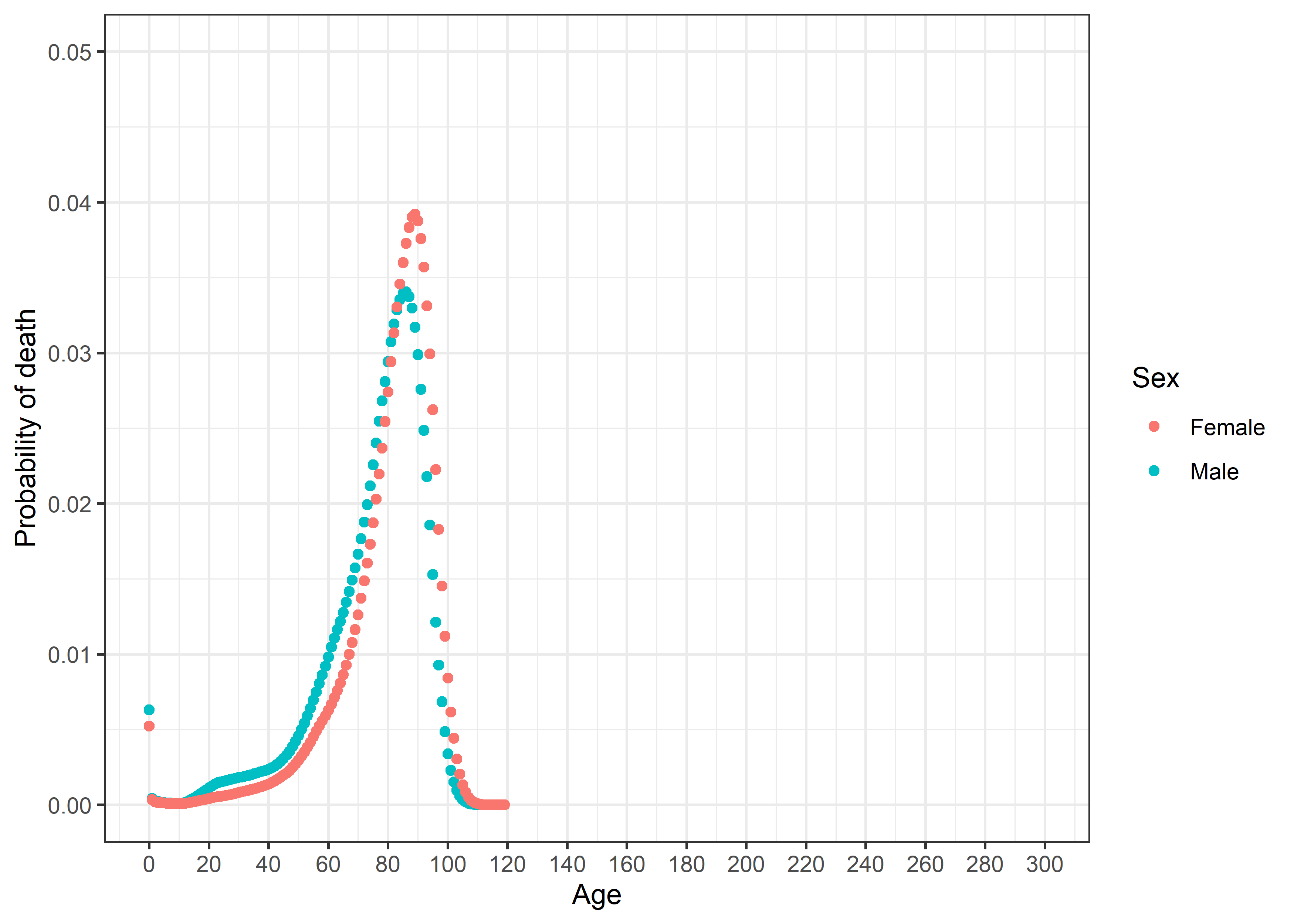
Year 0 is a particularly dangerous year due to risks at and shortly after birth, but mortality rates then remain low through Americans' 40s, rising sharply around the age of 50. Accordingly, the average age of death is 75.5 for men and 80.5 for women. However, this highlights that the probability of death is not constant over a lifetime but instead dramatically increases with old age. For comparison, if the average age of death was still 75.5 for men and 80.5 for women but the probability of death was constant for each year of someone's life, this would be the distribution of ages of death:
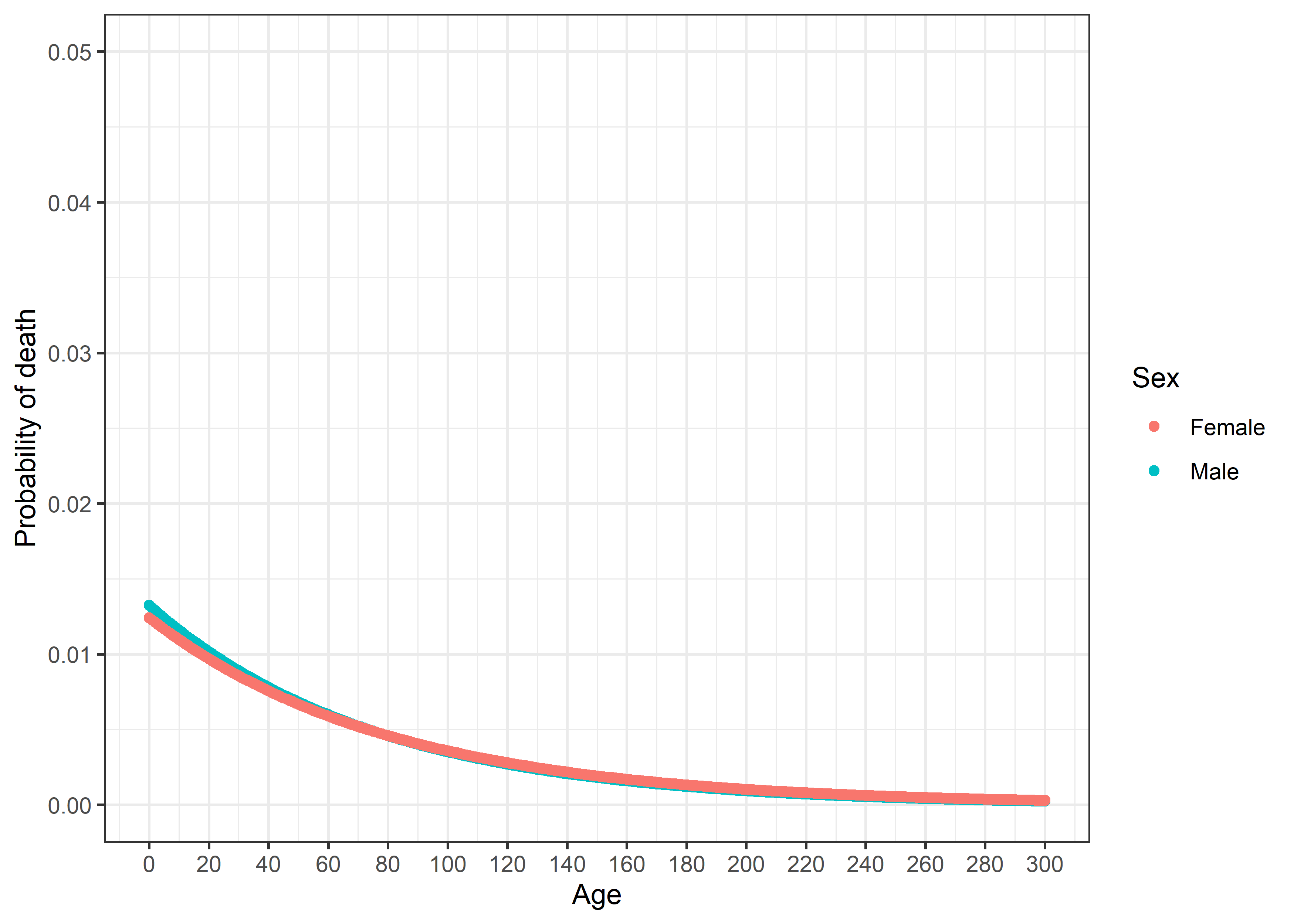
Though more people would die at a young (sub-50) age, many people would live into their 200s. Interestingly, because the probability of death is the same each year, a woman who survived to 100 would then have an expected age of death of 180.5, and a woman who survived to 200 would then have an expected age of death of 280.5, and so on. In this scenario, death is essentially an unlucky tails in an annual "coin of life" flip, so many lucky heads (years alive) don't decrease the chance of future heads (more years alive). This is in contrast to reality though, where a person's chance of dying increases every year after her tenth birthday. Essentially, a person's coin of life gets more and more weighted towards tails with each heads.
The first alternate model assumes that we manage to cure just aging, making everyone a permanent 30-year-old once they turn 30. That is, a person's chance of death remains the same as it currently is from birth to 30, but rather than continuing to climb after that, it just stays the same.
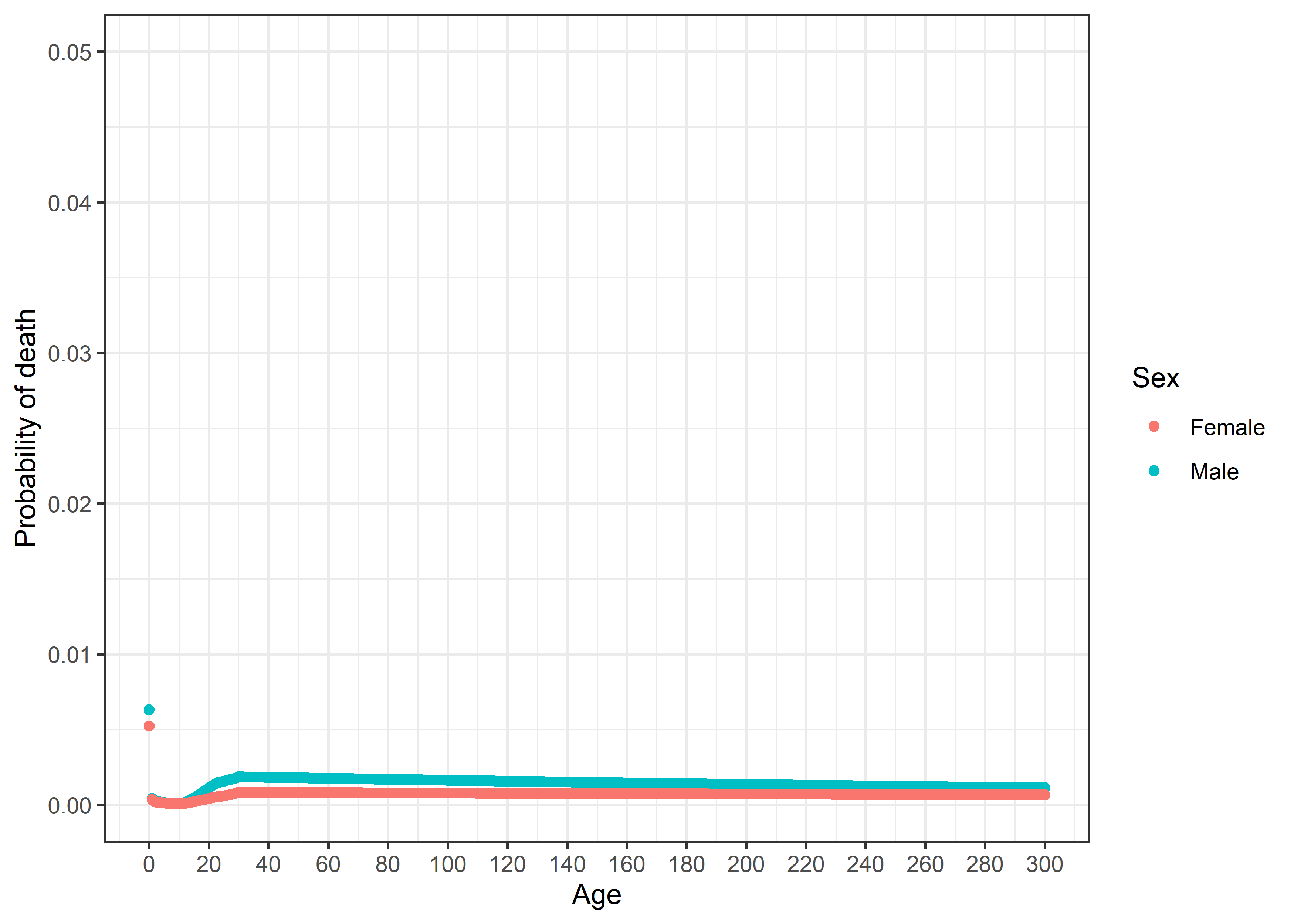
As expected, we see an initial climb but then a long, slowly decreasing tail as people die from car accidents, suicides, heart disease, or anything else that a 30-year-old could die from. To clarify, a 30-year-old, a 70-year-old, or a 110-year-old in this scenario could all still die from anything; they would just all have the same probability of dying from that thing rather than the 110-year-old being more susceptible to something like cancer or heart disease. Interestingly, the population dynamics already start to become strange: because men are more likely to die from almost any type of risk, the expected age of death for a man will become 565.7 while it will become more than double that at 1229.7 for a woman.
Admittedly, this scenario is not particularly likely: it would be bizarre if we managed to cure aging but simultaneously made no progress on things like diabetes or Alzheimer's. Therefore, the next scenario uses 2017 data from the CDC to look at what would happen if we cured both aging and all non-accident medical conditions in people 30 and older. (A note on the methods: this CDC document lists the 10 most common causes of death for 25-34 year-olds, so I am using the rates across that whole segment. I am assuming that most causes of death in the "other" category are health related and am therefore leaving only accidents (a catch-all for car accidents, unintentional poisoning, etc.), suicide, and assault (homicide).) That is, a person could still die from falling down the stairs or suicide, but no one would die of a stroke or kidney cancer.
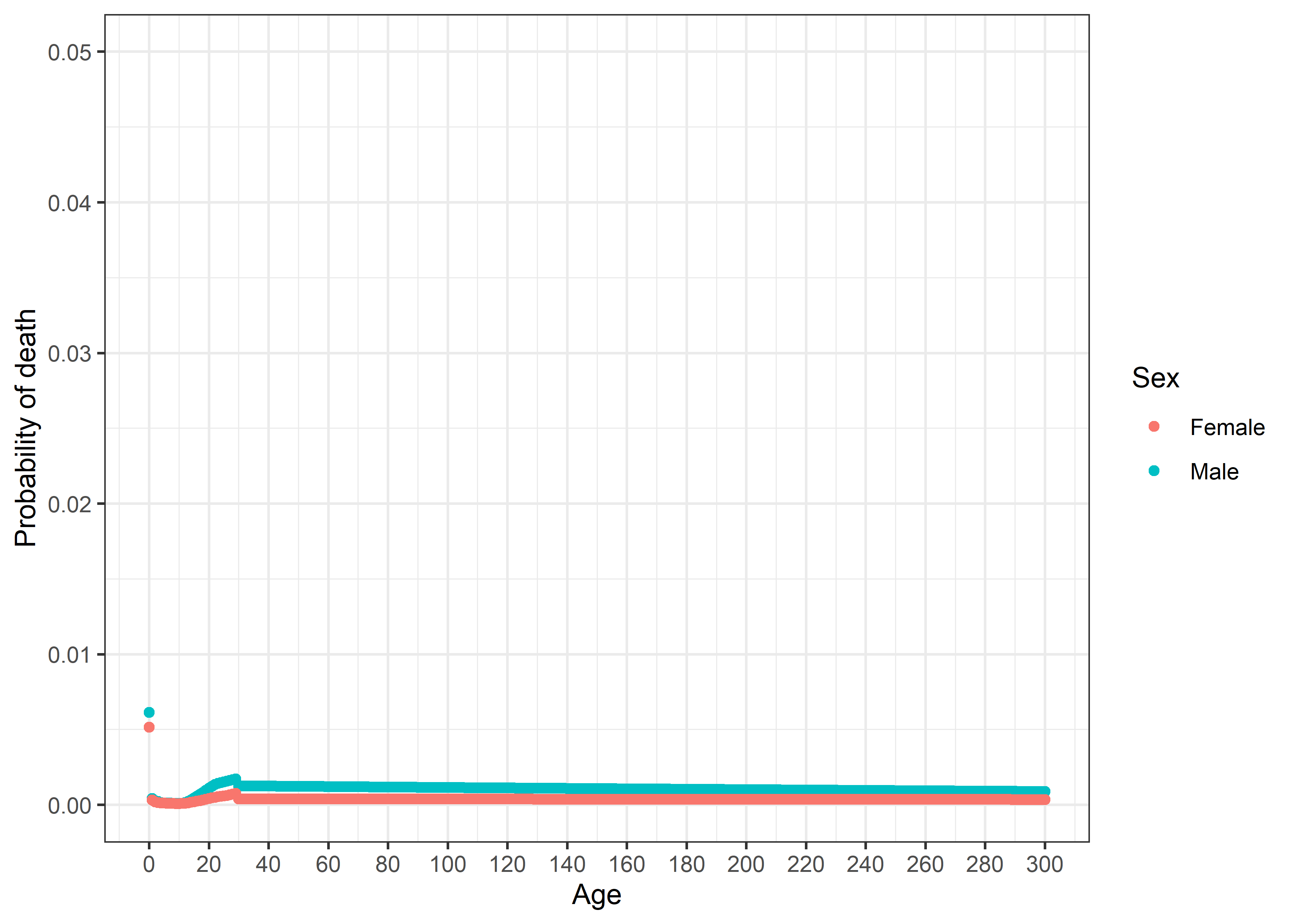
Here, the population statistics get even more wacky: the average age of death for a man becomes 776.5 while the average age of death for a woman becomes 2438.6.
However, at this point, accidents become a massive risk for people who would otherwise live hundreds or thousands of years, so it seems likely people would attempt to reduce their chance of death in an accident (a motorcycle crash, a fall off a ladder, etc.) to essentially 0. If they succeed, the model looks like this:
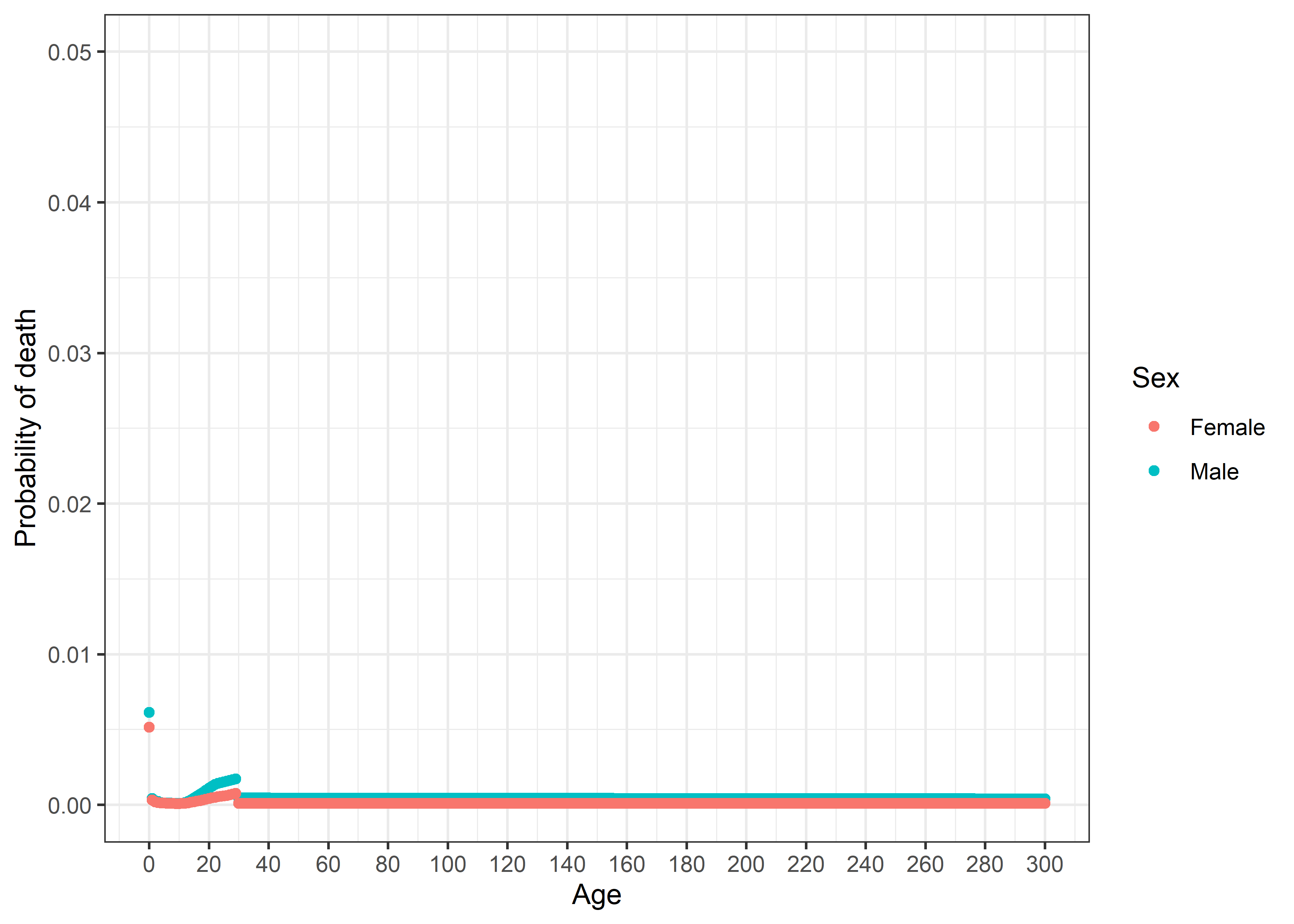
At this point, the only way a 30+ person can die would be from homicide or suicide. Indeed, with chances of death this low, the average age of death would become 2072.9 for a man and 8908.1 for a woman. With the prospect of living this long, it is likely the under-30 crowd would likewise do a better job avoiding accidents and health complications. To examine this, if we down-weight the probability of death at each age from 0 to 30 by the same amount that the above 30 crowd is downweighted when excluding accidents and health complications, we get this:
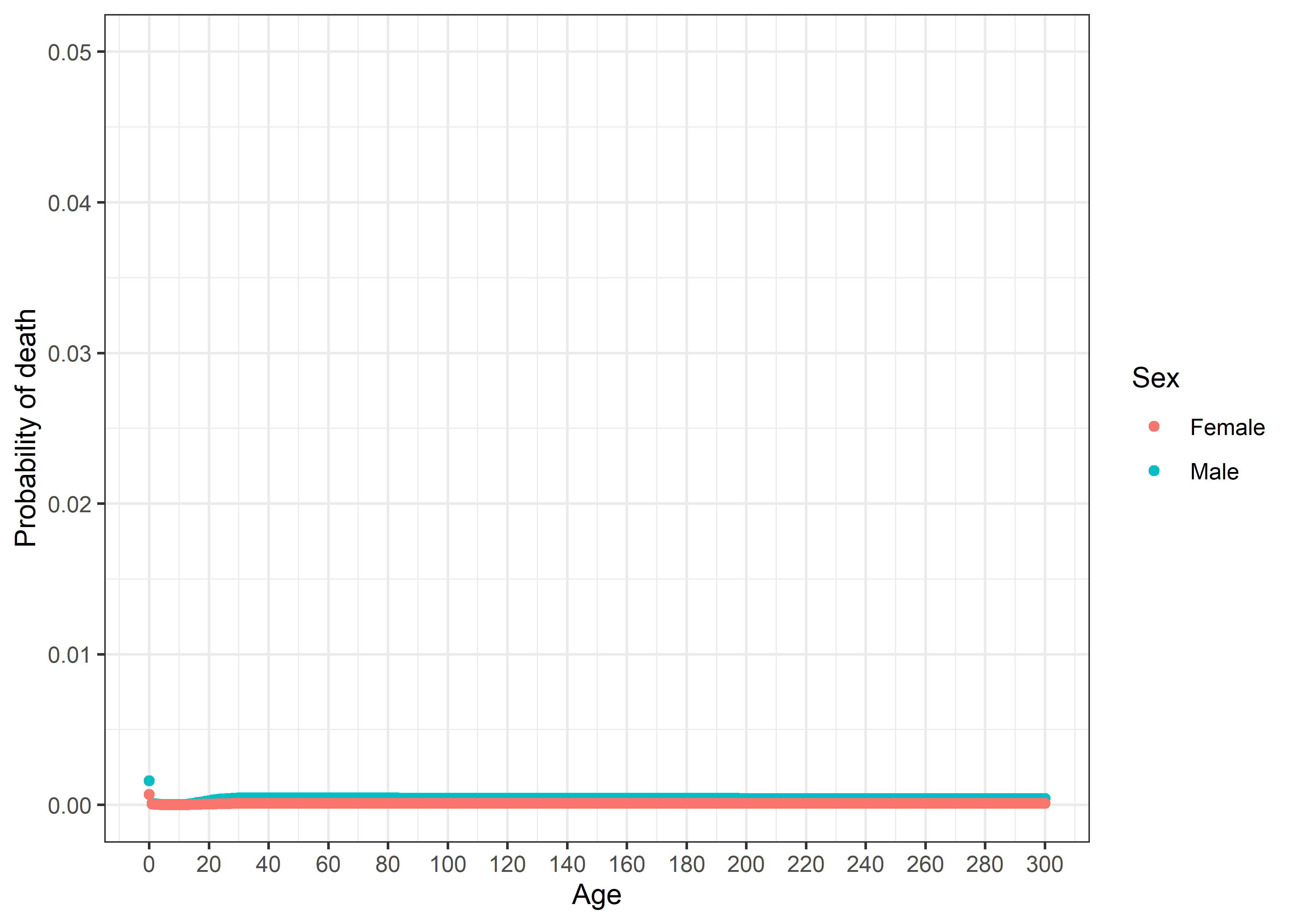
In this scenario, the average ages of death become 2115.0 for men and 9020 for women.
As I mentioned at the beginning, extrapolation on these time scales is bound to cause issues: some futurists believe we could upload our consciousnesses to the cloud by the end of this century, effectively ensuring immortality; new risks may emerge related to climate change or space travel; and violence may either decrease with increasing world peace or dramatically increase with inter-state violence and nuclear destruction. Still, I do find the dramatic gender imbalances and potential population boom associated with longevity interesting, and I hope that this will contribute to the conversation surrounding anti-aging research.
Interesting work, thanks!
The rising female:male life expectancy ratio is interesting, because it instinctively strikes me as absurd - there should be some feedback loop that pushes them back towards similar numbers - but it's not clear to me this intuition is much more than status quo bias.
Somewhat relatedly, you might find this interesting: research estimating generation length over history for both sexes. Surprisingly to me, they find massive variation over time; ~30,000 years ago the average generation length was around 24 for women, but more like 33 for men vs around 26 more recently, a very large difference. It's not the same metric, but related in that it suggests another way in which historically sexual parity forces were not that strong and tolerated considerable variation over time.