Comments
This report is a shallow dive into unexploded ordnance (UXO), landmines which is a sub-area within Global Health and Development. This report reflects approximately 40-50 hours of research and is informed by a 6-month internship I did with the programme and donor relations section of the United Nations Mine Action Service in the fall of 2021. The report offers a brief dive into whether we think a particular problem area is a promising area for either funders or founders to be working in. Being a shallow report, should be used to decide whether or not more research and work into a particular problem area should be prioritised. This report was produced as part of Cause Innovation Bootcamp’s fellowship program. Thank you to James Snowden, Akhil Bansal and Leonie Falk for providing feedback on earlier versions of this report. All errors are my own.
Summary
- Importance: The issue of UXOs and landmines impacts the health as well as income and most likely the mental health of individuals.. There are on average ~25,000 casualties (defined as severely injured or dead) from landmines, IEDs and UXOs per year (with 2/3rds being caused by IEDs). To put provide some context for this number, Malaria, one of the leading global killers, caused 643 000 deaths (95% UI 302 000–1 150 000) in 2019. This report aims to gauge the income, health and psychological effects of those casualty events.
- Tractability: Mine action is the umbrella term capturing all the activities aimed at addressing the problem of victim operated landmines, IEDs and other UXOs - meaning that the detonation is triggered by the victim itself. There are several interventions in mine action with four phases to tackle the problem: prevention, avoidance, demining, and victim assistance. Although the report attempts to provide some data on the cost-effectiveness of the different interventions there are several reasons why these estimates are highly uncertain. Furthermore, it is unclear if it would be possible to scale the most cost-effective interventions while keeping the level of cost-effectiveness.
- Neglectedness: The United Nations Mine Action service functions as the coordinating body for a lot of the funding and efforts in international mine action and moves around 65 million USD. The two biggest implementers are the Mines Advisory Group (90 million USD) and the HALO Trust (100 million USD). Most of that funding comes from high income country governments. These grants often include a political component in where the activities are taking place. It is unclear how effectively these resources are allocated and how many casualties they are preventing each year.
Main Takeaways
- Biggest uncertainties:
- The poor data availability allows for only low levels of confidence in many conclusions.
- It is highly uncertain what the economic effects of landmines contamination actually are. Since we would expect that these effects make up a majority of the positive benefit, our cost-effectiveness estimates are highly uncertain.
- Recommendations for philanthropist and why:
- The research has led to the recommendation to inquire directly with mine action organisations on what they deem the most cost-effective area or intervention to fund, since such data is highly dependent on the factors which cannot easily be predicted.
- Ukraine is being heavily contaminated by unexploded ordnance right now, especially in its east, the severity and need of the contamination will require a lot of funding and could be potentially very cost effective due to the dense nature of the contaminants as well as the terrain. Mechanical demining could be an appropriate method which could be highly cost-effective. The wide scale decontamination can only start once the fighting has ebbed off which might take some time.
- At present I´d consider funding Apopo, since they - at least according to self published data - are cost-effective.
- Next steps for someone spending more time?
- I encourage efforts to gather data on cost effectiveness, health effects, and the economic impact of landmines. Which is an area which currently lacks clear and conclusive data.
- I´d recommend talking to experts in the field, most have tremendous experience and tell which interventions are most effective in which contexts. A word of caution though, a too narrow focus on cost-effectiveness can possibly be understood as dangerous since the consequences of efforts in this field are often deadly. The safety of deminers needs to be always the most important consideration.
What is the problem?
Wars and armed conflicts almost always have the intended and unintended effect of leaving unexploded ordnance, or UXO, (for the purpose of this report UXO and ERW - explosive remnants of war - shall be used interchangeably) behind which is called contamination. The form of contamination varies widely between types of conflicts, intensity, tactics, and actors involved. The main forms of UXO contamination are:
- Landmines: A land mine is an explosive device concealed under or on the ground and designed to destroy or disable enemy targets, ranging from combatants to vehicles and tanks, as they pass over or near it. Such a device is typically victim operated, meaning that one or several inputs of the victims cause the detonation. Most mines are set off by pressure when a target steps on it or drives over it, although other detonation mechanisms are also sometimes used. Other mines like anti-tank mines use higher pressures or magnetism.
- Improvised Explosive Devices (IEDs): An improvised explosive device is a bomb constructed and deployed in ways other than in conventional military action. It may be constructed of conventional military explosives, such as an artillery shell, attached to a detonating mechanism or can be a pipe bomb; countless versions exist. IEDs are commonly used as roadside bombs, or in urban areas.
- Unexploded ordnances: Unexploded ordnance (UXO), or also called, explosive remnants of war (ERW) are explosive weapons (bombs, shells, grenades, land mines, naval mines, cluster munition, and other munitions) that did not explode when they were employed and still pose a risk of detonation, sometimes many decades after they were used or discarded.
Different forms of contamination require different interventions, which vary in cost and skill level required. As an example (exceptions are to be expected), landmines are, once found, relatively easy and safe to disarm and destroy by trained personnel. Landmines also vary in form, mainly anti-personnel landmines, anti-tank mines and sea mines (which shall not be considered in this report due to their rare occurrence and relatively low impact on civilians), different types of mines are made from different materials (plastic, metal), contain various explosives (some are designed to kill whilst other aim to maim).
In the last decades we have seen a shift to asymmetrical warfare tactics between state and non-state actors, increasing the usage of IEDs. IEDs alone have been reported in over 50 different countries resulting in over 170,000 casualties (defined as severely injured or dead) between 2011 and 2021. This means on average, there were 17,000 casualties per year from IEDs.
Additionally, according to the International Campaign to Ban Landmines in 2020, at least 7,073 people were killed or injured by landmines or UXOs. Of that at least 2,492 were killed whilst 4,561 were injured. In total, this means that there are ~25,000 casualties from landmines, IEDs and UXOs per year (with 2/3rds being caused by IEDs).
The safe disarmament of IEDs often required highly trained personnel and tools depending on type and construction. IEDs are generally more difficult to work with since they can vary between a simple contraption like a canister filled with nails to heavy artillery shells fitted with sophisticated pressure of magnetism sensors.
The ongoing invasion of Russia into the Ukraine has caused new and widespread contamination which will take years to clear. New figures from the ongoing war in Ukraine indicate a stark increase in the usage of cluster bombs, with children making up two thirds of the casualties of cluster munition victims. In 2020, cluster munitions caused 360 casualties, over 60% were legacy munitions. The first half of 2022 has already created at least 689 civilian casualties from cluster munitions, 215 died, this is a 300% increase compared to 2021. The cleanup effort in Ukraine will be massive and the dense contamination especially in the east of the country could be an area in the future where demining could become much more cost effective. It is safe to assume that Ukraine will suffer from increased contamination and that locally casualties will rise once fighting has ceased.
Whom does it affect and at what point in their lives?
Mines and IEDs affect people in various ways. Most are designed to gain a tactical advantage over your opponent in warfare, but some are also used in area denial tactics, which aim to slow down or prevent personnel combatants and civilians from entering an area. This report shall focus on explosives which pose the biggest risk to humans and thus excludes areas such e.g., the demilitarised zone between the two Koreas which is highly contaminated but well managed and no actor is interested in removing such devices.
Despite the various forms of ordnance, they mostly kill and injure civilians (after combat has ceased). Within that, children are most at risk of falling victim. To illustrate, the 2021 victims of cluster munitions were 97% civilians and 66% of that were children: “Children are far more likely to die from landmine injuries than adults. An estimated 85 percent of child victims of landmines die before reaching the hospital”.
What is the causal pathway through which this issue affects health/income/well-being and how big are those effects?
It seems safe to assume that landmines and UXOs have effects on a population’s health, income and mental well-being. From the literature I could find, the health effects are the most documented and quantified, the income effects are very uncertain and there is little data on quantifying the mental well-being effects of landmines. I have ordered the following sections accordingly, starting with health effects.
Health: Dying and being injured from the explosion of an UXO or landmine:
- There is relatively good data on the number of casualties from ordnance.
The causality of the adverse health effects is straight forward, a piece of ordnance detonates whilst a person is within the blast radius. The severity of the blast and effect on casualty is dependent on many factors and varies from minor shrapnel wounds (which are often not recorded), the loss of limbs (many mines are not designed to kill but rather to maim, thus gaining military advantage), or death.
- The casualty database for Landmine Monitor Report 2018 includes an updated total of 9,437 casualties for 2016 2,472 killed, 6,937 injured, and 28 unknown. This number could easily be a lot higher since many of the deaths are happening in countries that still have an ongoing conflict and/or have unreliable public data on the issue. It is to be expected that the war in Ukraine is going to drive that number up considerably over the next decades. If we assume that each life translates into 30 DALYs on average (which is a conservative assumption as this seems to disproportionately affect children) and that injury causes 5 DALYs on average (random assumption with low confidence), the overall burden of disease of landmines is about 2,472 x 30 + 6,937 x 5 = 108,845 DALYs.
Mental Well-being
- The knowledge that you, someone you know or your children could be hurt: The psychological toll that it takes on someone’s mind to know that you, your children or someone you know is in danger of being hurt by an unexploded ordnance in your environment.
- The psychological toll on someone who has been injured by a landmine: It’s not hard to imagine that being injured by an unexploded ordnance or landmine could lead to serious trauma and PTSD or other similar mental health issues (there is some evidence to support this here, here, here, and here).
- Psychological toll of someone being killed by a landmine and UXO: Being killed by an exploded landmine is a particularly gruesome death. Even though death might come instantly to the individual (many mines are not designed to kill but rather to maim, thus gaining military advantage), it is not hard to imagine that the psychological toll on the first responders and family members could be significant. Secondary trauma is real and has major effects on first responders and immediate surroundings. I did not attempt to quantify this effect and could not find literature on the topic. One reason for that could be that this line of question could be quite sensitive and somewhat inappropriate for the victim’s family. As well as that there is basically no data focusing on these effects, they mostly deal with health outcomes.
It is hard to quantify these psychological effects and I was not able to make a reliable estimate that breaks down the burden per piece of unexploded ordnance.
Economic: Fields for agriculture and access public infrastructure like roads:
- The threat – real or perceived – contamination is often enough for people to stop using a road, field, or house or other forms of public infrastructure (e.g. reaching a hospital or a school). This natural instinct is often exploited to exert economic damage and prevent mobility. Often IEDs are placed on strategically important roads and prevent militaries and civilians from accessing public infrastructure.
- There are some authors who seem to have tried to quantify the economic burden of UXO contamination but there does not seem to be high quality data and the results from those analyses vary quite widely. It also seems safe to assume that the economic costs do depend on the context (as a random piece of forest might not be as productive as a road connecting two population hubs). Also, many places which are contaminated with UXOs suffer from a complex mix of economic risk factors.
- Merrouche (2006) found that landmine contamination causes a loss of 0.4 years of education on average and also found that landmine contamination has large and statistically significant negative effects on poverty and consumption per capita.
- Harris (2000) found that the annual costs of completely demining Cambodia would be $US140 million, whereas the annual benefits are only $0.7 million.
- Furthermore, Harris (2002) found that the investment of $100 million for demining in Afghanistan would result in annual benefits of $50.3 million per annum.
- All of these assessments are rather old and the quality of these evaluations is questionable. In general, it seems safe to assume that there are some economic costs from landmine contamination but how large this effect is remains an unresolved question and would most likely be fairly context specific which is why I have refrained from putting down numbers here. Micro-geography is crucial, a random contaminated hill might not inhibit one's life much, a strategic roadway just next to it is likely to cause much more harm (economically, mentally and physically).
History of the problem
The first reports of victim operated (meaning the ordnance explodes through the actions or presence of its victim) mines stem from the 1853-1856 Crimean war where a coalition of Ottomans, French, and Sardinian forces fought against the Russian Empire (Youngblood, 2002). World War I saw the introduction of the first industrially produced landmines. Since then, the development of mines has branched into many different subgroups suitable for specific objectives.
The indiscriminate nature of victim operated explosives has drawn plenty of criticism over the years. Especially since most models are durable and can be deadly even decades after a conflict, additionally many mines are designed to blend into the environment or are deliberately made ‘shiny’ attracting kids.
Until the 1990s mines have been used by most militaries in some form or another. As a result of increasing scrutiny over the thousands of deaths annually, the International Campaign to Ban Landmines (ITCBL) was founded in 1992. It brought forth the Mine Ban Treaty in 1997 – which was awarded the Nobel Peace Prize – which included a comprehensive ban on all anti-personnel mines as well as several measures to redress the harm from past use. So far 164 states have ratified and accepted the treaty, 32 states are non-signatories, amongst them are the United States, Russia, China, the two Koreas, Pakistan, India, Iran, Israel, Syria.
In June 2022, the United States changed its policy and in effect aligned itself with the provisions of the Mine Ban Treaty, except for the defence of the Korean Peninsula. This shift in US position is a good sign and might create some knock-on effects (the exemption of the Korean Peninsula is not very significant since minefields there are used for protection, are well documented and sealed off, thus pose very low risks for civilians).
Is it likely to get better, worse or stay the same with the status quo?
The issue of landmines is likely to become better in the future since the “Mine Ban Treaty has created a powerful and near universal stigma against antipersonnel landmines: most states not party to the treaty are responding to international pressure on this issue and have stopped using, producing, and transferring the weapon. They are in de facto compliance with the treaty even though they are not legally bound by it” (International Coalition to Ban Landmines, n.d.). Having said that, landmines have been used during the ongoing invasion of Russia into Ukraine and there might be other states that would be willing to use them in case of an inter state conflict.
Meanwhile, the issue of IEDs and UXOs is likely to get worse. The continued proliferation of IEDs through readily available instructions from the internet is likely to continue. Furthermore, there is a general trend from interstate to interstate conflict which means that the conflict parties don’t have as much systematic access to landmines as they have to improvised explosive devices.
Similarly, unexploded ordnance which is a byproduct of practically every war or conflict will remain and could increase if more wars are being fought. A large conflict between states (US vs China, Russia vs NATO) even if fought with conventional weapons would cause widespread contamination. If Taiwan were to be attacked by China it would require an amphibious landing which would likely be countered with widespread mine usage.
The ongoing war in Ukraine following the invasion of the Russian Federation continues to cause intense contamination which will require large-scale clearance efforts for years to come. Especially the wide scale use of cluster munitions by Russia causes dangerous UXO. According to the United Nations up to 40% of submunitions (one cluster bomb contains between 100-400 submunitions which are supposed to detonate upon impact) do not explode, thus creating thousands of UXOs. The usage of cluster munitions is outlawed under the 2008 Convention on Cluster Munitions – Russia is not party to the treaty.
Some of the most effective interventions against traditional landmines don’t work as well against improvised explosive devices and the proportion of IEDs is increasing compared to landmines and UXOs. Having said that, the progress is slow and conflicts like the one in Ukraine are reverting some of these trends. This means that concerted efforts are necessary right now and will be necessary in the future to protect civilians from the harm that these unexploded devices cause to their health, economy and psychological well-being. It doesn’t seem like this problem will be solved without these concerted efforts and the cost-effectiveness of the interventions should not change dramatically in the next 10-15 years.
Type and location of the problem
Landmines, IEDs and UXOs are differ in many ways and thus are used by various actors in different places. There is no data source which bundles all forms of contamination in one place. I have gathered sources to provide a rough overview in the respective categories. Most casualties occur due to the use of IEDs and explosive remnants of war, anti-personnel mines constitute only a part of the issue (Landmine Monitor, 2022).
Cluster Munition remnants
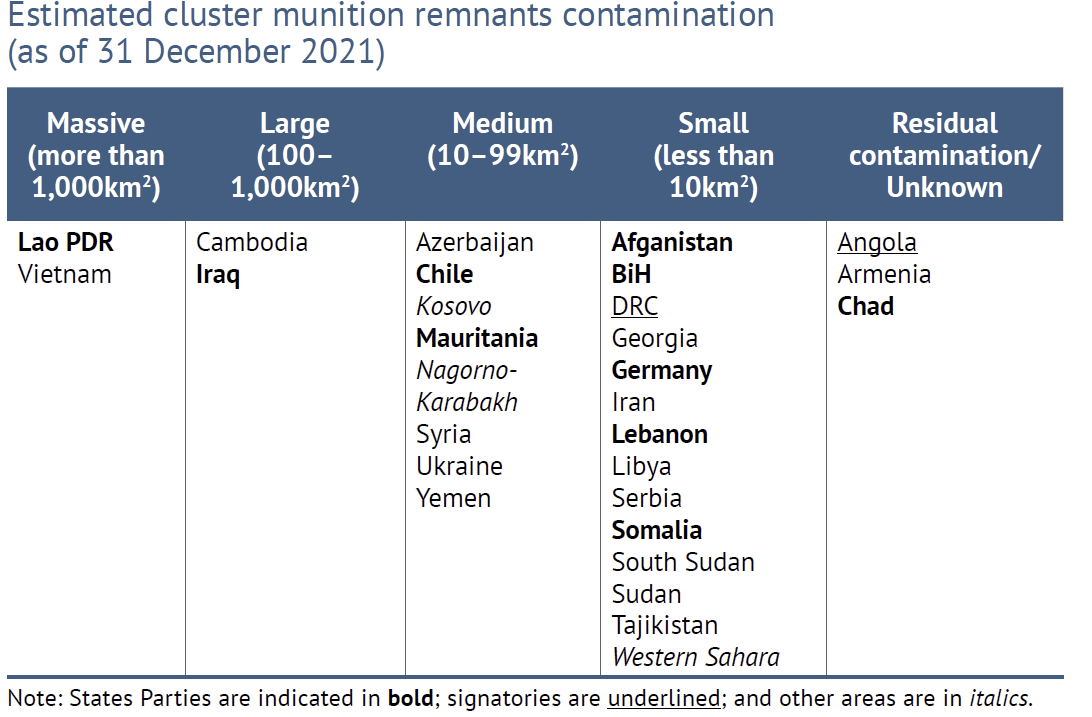
A cluster munition is a form of air-dropped or ground-launched explosive weapon that releases or ejects smaller submunitions. Commonly, this is a cluster bomb that ejects explosive bomblets that are designed to kill personnel and destroy vehicles or to scatter land mines. Because cluster bombs release many small bomblets over a wide area, they pose risks to civilians both during attacks and afterwards. Unexploded bomblets can kill or maim civilians and/or unintended targets long after a conflict has ended, and are costly to locate and remove.
Cluster munitions are prohibited for those nations that ratified the Convention on Cluster Munitions, adopted in Dublin, Ireland, in May 2008. The Convention entered into force and became binding international law upon ratifying states on 1 August 2010, six months after being ratified by 30 states. As of 10 February 2022, a total of 123 states have joined the Convention, as 110 states parties. Russia has made wide scale use of cluster munitions in the Ukraine war contaminating vast swaths of Ukraine with unexploded submunitions. The cleanup according to the HALO Trust is set to last many decades. Neither Ukraine nor Russia are party to the convention.
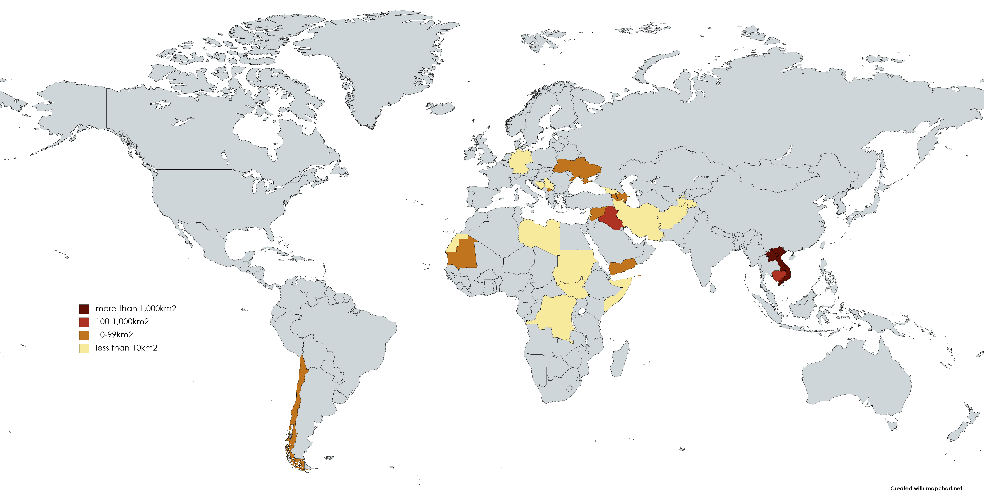
Prior to the Ukraine war most cluster munition remnants could be found in Laos and Vietnam. As a result of the US bombardment of the respective countries. Ukraine by now is even more contaminated and also presents a more complex and more urban contamination.
Landmine contamination
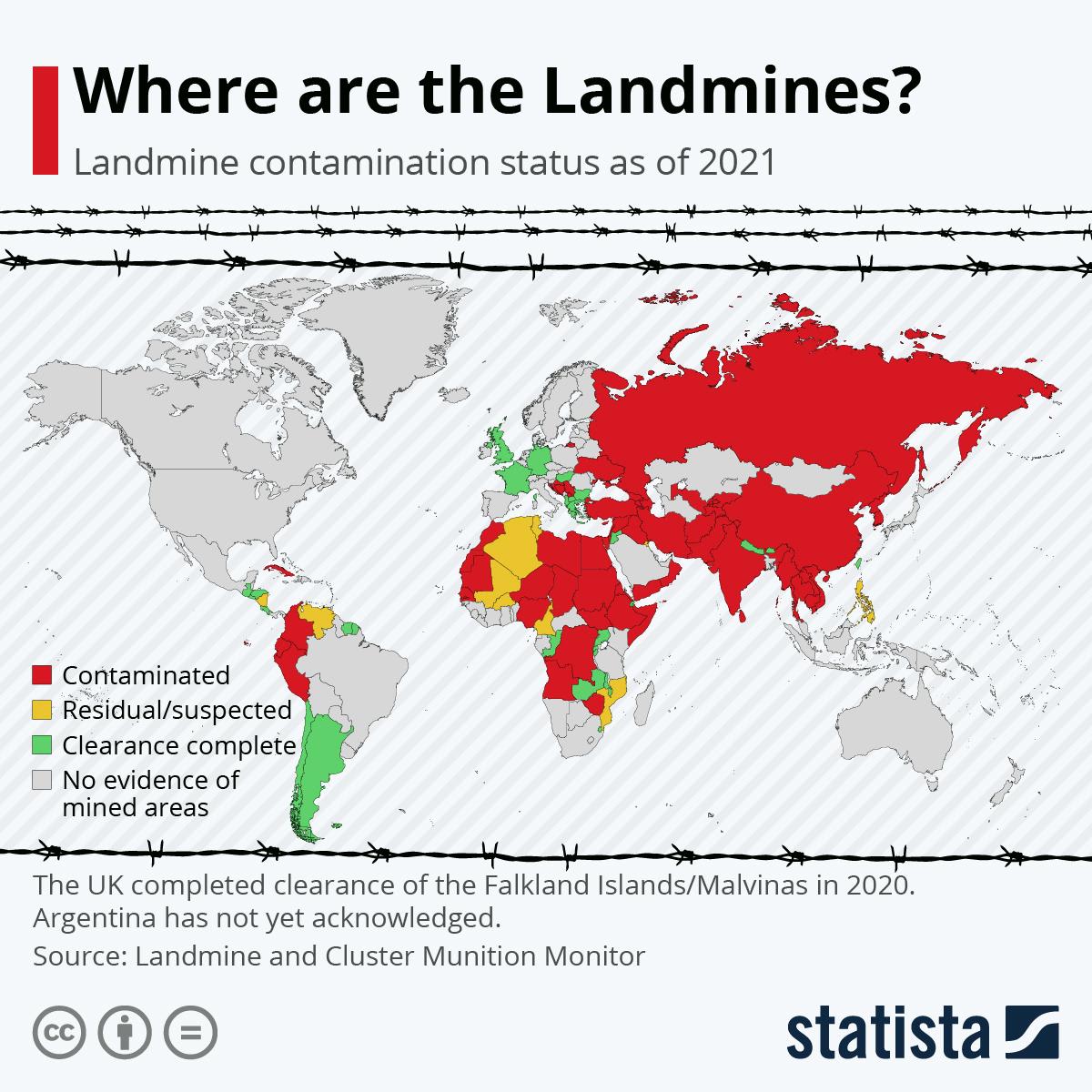
Compared to cluster munition, landmines are more widespread. Clearance efforts in South America have progressed, with clearance completed in Argentina and Chile but remaining in Ecuador and Columbia. Many Countries in Sub Saharan and North Africa are contaminated as are large parts of SouthEast Asia as well as Russia. Casualties of mines and ERW have been recorded in 47 countries.
Improvised Explosive Devices
There is no good data on the quantity or geographic distribution of IEDs but they are found mostly in former and active conflicts of the last 30 years. IEDs are classified as landmines thus data on them is less precise.
Landmine and Cluster Munition Monitor Report 2022 (p. 50)
The countries with the highest contamination are not necessarily the countries with the highest casualties (e.g. contaminated areas are not close to population centres). The countries with the highest casualties over time are represented in the graph below.
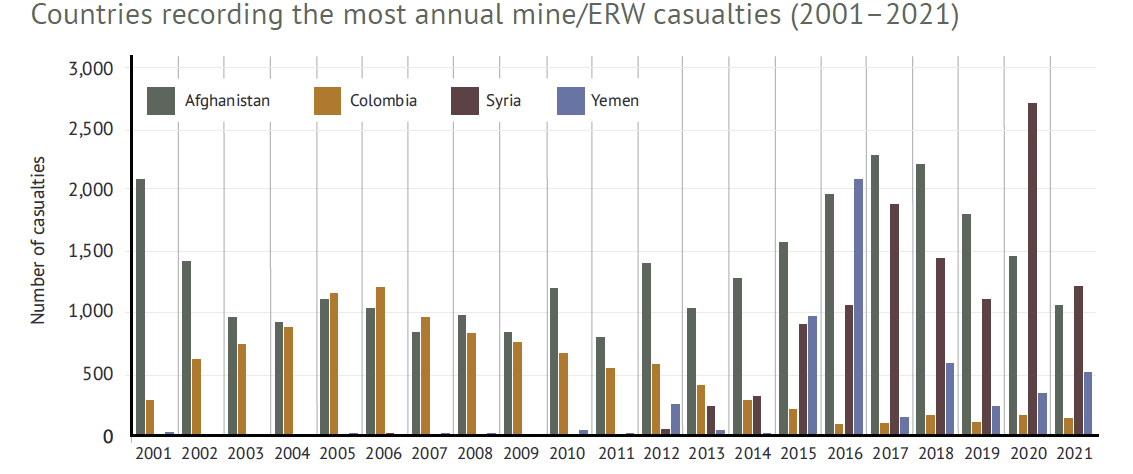
Landmine and Cluster Munition Monitor Report 2022
Tractability
What would this issue look like in an ideal world?
An ideal scenario would be that there aren’t any armed conflicts and wars thus no mines/UXOs or other weapons used. Since that is very unlikely, a more sensible ideal would be, to have conflicting parties (state and non-state actors) not use landmines and IEDs, and also ensure that there are no ERW (explosive remnants of war), or that the they are clearly marked and known to all parties and civilians. Weapons such as cluster bombs should not be used at all since they create devastating contamination which requires intense clearance operations. Better communication of contamination is necessary to reduce accidents and civilian casualties.
What are the different interventions? And what do they cost
Demining is a well-established field which has seen many innovations to effectively address the problems at hand. There are four phases to tackle the problem: prevention, avoidance, demining, and victim assistance. The individual interventions are listed in the section below which include the Theory of Change for the Intervention as well as the individual Back of the Envelope calculations for cost-effectiveness of these interventions. There are several reasons why I have very low confidence in these calculations. The following factors could change these assessments considerably:
- The impact of landmines and UXOs on people’s health, happiness and income are highly uncertain: As outlined earlier, there are still significant challenges in getting accurate information of the number of people killed and injured by UXOs annually. Furthermore, there are wide confidence intervals around the economic effects of landmine and UXO contamination and low evidence on the effects on happiness of people living in contaminated areas.
- We don’t know the risk: Next to not knowing the effects the contamination of land has, we also don’t exactly know what the risk is for individuals to be exposed to those risks.
- There might be other positive impacts of these interventions that are hard to model: The former chief of mine action for UNMAS Afghanistan (consulted for background conversations) has mentioned furthermore that the employment of several hundred or thousand deminers who are almost exclusively men in fighting age has a profound impact on the ability of insurgents to recruit them. Mine action thus gives them a skill, money and they are far less likely to join organisations such as the Taliban (this refers to the situation pre Taliban takeover in 2021, but the principle very much remains). Weighing the impact of these very real knock-on effects is very challenging but shall not be forgotten when reviewing the cost effectiveness of mine action.
- The cost-effectiveness of these interventions is highly context dependent: It is important to be conscious of the fact that the most appropriate intervention is dependent on the type of contamination, terrain, vegetation, logistics and labour costs. Current implementing organisations have many decades of experience of choosing the most appropriate – and cost effective – method. This perspective was mirrored by Richard MacCormac, Head of Humanitarian Disarmament and Peacebuilding at the Danish Refugee Council who was contacted as part of the research. This means that even though an intervention might be cost-effective in a specific location, it might not be able to scale at that level of cost-effectiveness.
In general, it is fairly complicated to assess the risk of landmines and the data here is hard to come by or not public, thus basically not usable. Having made an attempt at quantifying the impact per landmine removed anyway, we come to the following calculation:
According to LandmineFree.org there are around 110 million landmines in the ground, with 5000 people being killed each year meaning 5000 out of 110 million landmines detonate and kill a person each year. This means that if we assume that both of those numbers are correct, the chance of one of the landmines getting off and killing a person is 5000/110,000,000 = 0.000045.
This is making the assumption that the risk for all landmines killing a person are equal which is not the case. For example, there could be a landmine in a very remote mountainous region that was strategically important during some war long ago but isn’t actually frequented by the local population today and therefore unlikely to cause any harm. On the other end of the spectrum, there might be a very recent post-conflict region that has lots of landmines in fields to which the local population is now returning to. The likelihood of these landmines creating harm is a lot higher but unfortunately, we don’t know how much higher that would be.
One example of a place that would most likely be more recent and more dangerous would be Yemen. A Yemeni de-mining official had claimed that there were 500,000 mines since 2015 (report from 2018) and the Landmine and Cluster Munition Monitor, an initiative that checks compliance with the Mine Ban Treaty, reported about three thousand casualties in 2015-16 (Elana DeLozier, 2018). If we assume that all the mines were put in during the first year, the likelihood of one of the mines killing a person was 3000/500,000 = 0.006.
This number seems more relevant but still under reported as mine clearance efforts are most likely focusing on the areas of the most dangerous contamination even within these priority countries. The value of removing one landmine is therefore most likely higher than the number estimated above. Generally, it doesn’t seem unlikely that removing one landmine from a priority area would be twice or even four times as valuable.
Furthermore, removing a landmine in a given year would not only reduce the risk of a person being killed during that year but also in the future until the landmine’s function expires which can be longer than 50 years. Having said that, people would most likely learn over time which areas are safe and which aren't, which would also mean that casualty numbers would decrease over time. Economic effects on the other hand would not decrease as fields and roads remain unusable but since we don’t have good data on this, they are not included here.
If we take the case of Columbia from the graph discussed earlier we can see that casualty numbers decrease by around 10% each year for around 10 years. If we take the earlier number of 0.006 chance of a landmine killing someone and model the removal of that landmine over 10 years, the likelihood of that landmine killing a person over 10 years would come out to: 0.006 + 0.006 * 0.9 + 0.006 * 0.8 + 0.006 * 0.7 + 0.006 * 0.6 + 0.006 * 0.5 + 0.006 * 0.4 + 0.006 * 0.3 + 0.006 * 0.2 + 0.006* 0.1 = 0.033. By removing one landmine we have therefore removed a 0.033 chance of killing a person.
If we assume that each life translates into 30 DALYs on average (which is a conservative assumption as this seems to disproportionately affect children) removing one landmine equals saving 0.033x 30 DALYs = 0.99 DALYS. This means that for this to be a cost-effective intervention, a project would have to clear one landmine for less than $101.00 USD (if $100/DALY is the threshold). The below table outlines the cost-effectiveness and tractability of the different interventions.
| Category | Intervention | Evidence of this working | Cost- effectiveness |
| Prevention | Advocating for Mine Ban treaty | Low | Low |
| Community groups advocating for the non-usage to their government/ military | Low | Low | |
| Avoidance | Surveying (fencing off areas that are high risk, warning labels) | Moderate | High |
| Explosive ordnance risk education (EORE) | Low | Moderate | |
| Demining | Using detectors to demine areas contaminated with UXOs | Moderate-High | Very High |
| Animals like rats and dogs | Moderate-High | Moderate- High | |
| Mechanical (excavators and other heavy machinery) | Moderate | Moderate | |
| New demining technology (drones, other technology) | Moderate | n.a. | |
| Victim Assistance | Helping victims immediately after an exposure and long term to live with the results of injury | Low | High |
In general, it seems like preventing landmines and UXOs from being used could be highly cost-effective but is very intractable, especially considering that most UXOs are IEDs that cannot be regulated by any centralised actors. Avoidance of UXOs could have some effect on the outcome but as a stand alone measure is hardly sensible.
It is unclear if there is an effect on casualties and how big the reduction would be. Furthermore, it just means that people are more diligent in avoiding contaminated areas but it does not mean that areas become usable again which means the intervention has no economic effect. This is therefore also not a common practice, surveying and clearance usually go hand in hand.
The most promising interventions are within the UXO clearance section with animals like rats and dogs, deminers with metal detectors and mechanical excavators being able to clear land and make it usable again. Victim assistance seems to have the lowest cost-effectiveness as most of the harm has already happened.
Preventing civilians from being exposed
Advocating for Mine Ban treaty
ToC: A civil society group advocates their government -> the government brings up a treaty for discussion-> other states are willing to joining-> treaty is drafted -> treaty is signed -> treaty is ratified -> states stop using UXOs -> less exposure during and after war -> less economic, psychological and physical harm. Assumptions:
|
It doesn’t actually matter if a treaty is cost-effective in itself because policy has been in existence for 20 years. The only progress that could be made on this might be to advocate non-signatories to join the treaty. Having said that, it makes sense to think through the cost-effectiveness of a treaty like this to get a general sense if legislation like this could be relevant for other harmful weapons of war for which a treaty does not exist yet and how important it would be to get non-signatories to join. To understand the potential cost-effectiveness of advocating for a policy like this, two factors are relevant:
- The total cost of an advocacy campaign and implementation of the policy: The International Coalition to Ban Landmines spent $1,312,753 in 2021 (Annual Report 2021, p. 18). Most of the funding seems to be spent on collecting data on landmines deaths and injuries and some of it on direct advocacy efforts. The costs for advocating could be a lot higher than taking this number and multiplying it by the years since the ban because of two reasons: (1) the ICBL is a coalition of many other organisations who are also spending part of their budget on this issue, (2) it probably cost a lot more during the implementation and advocacy phase. If we calculate for the best case scenario, we assume that they have started advocating in 1990 (assumption with no background information) and spend ~$1.5 million every year since today which would come out to $1.5 mil x 22 years: 33 million.
- The reduction in death and injury due to the policy: it is really hard to understand how much the treaty can be credited with reducing the numbers of victims because of two reasons: (1) we don’t know how the numbers of deaths would have developed otherwise (e.g. anti-personnel mines would have lost their tactical advantage compared to IEDs which are not state bound) and (2) we don’t have any concrete data on deaths from UXOs before 1999 which is when the landmine monitor started collecting them which is very inconvenient. If we assume that the policy takes a couple of years to implement, we can take the first data point available and assume that this was the baseline which the treaty was reducing. If we ignore that the number of casualties and injuries rise after 2013 we could assume that the treaty reduces the number of casualties by 3000 every year we would come out to 3000 x 22 = 66,000 casualties avoided of which ¼ actually die, if we round this to ⅓ to include the injuries, it comes out to 33,000 deaths averted over time.
These two factors mean that under these baseline assumptions (which are most definitely off by far) the mine ban treaty averted a death for $1000 in a best case scenario. Most likely though the costs were significantly higher and the fact that we basically have no data on landmine deaths before and after the treaty and that casualties have risen over the last 5 years to a level of 2001 means that we don’t actually know if the treaty had any effect on landmine casualties at all. On the other hand, there are most likely some benefits to the treaty that are not included here such as: a reduction in stockpiles meaning deaths averted in the future, the stigma of usage is likely to reduce mine application, and economic effects that are not captured here and the benefit of international cooperation and collaboration on an issue.
There are two treaties that already exist that are relevant to understand how tractable a policy would be regarding the reduction of injuries and landmines from unexploded ordnances. Feel free to skip this section if you are not interested in the details and go to the next intervention.
- Mine Ban Treaty (Ottawa, 1997):
- There is a global coalition of nongovernmental organisations chaired by Human Rights Watch called the International Campaign to Ban Landmines (ICBL). The coalition has received the 1997 Nobel Peace Prize for the Mine Ban Treaty that was adopted in 1997 which prohibits the use of antipersonnel mines and requires countries to destroy stockpiles, clear mine-affected areas, and assist victims. A total of 164 countries are party to the treaty including all NATO members except the United States. In June 2022, US President Joe Biden changed policy and aligned US policy with the provisions of the mine ban treaty with the exception of the Korean Peninsula meaning that except for in the Koreas - particularly their so called Demilitarized Zone the US will be in alignment with the eventual goal (without specific details) to formally join the treaty.
- Between 2021 and 2022 anti-personnel mines have been used by Russia, Myanmar and Ukraine (not yet independently confirmed but highly likely) (Landmine Monitor, 2022). This does not mean that other states did not suffer from existing contamination.
- Non-state armed groups have recently used victim-operated explosives amongst others in the Central African Republic, Colombia, Democratic Republic of Congo, India, and Myanmar. This new use by armed groups mostly involved victim-operated explosive devices of an improvised nature made from locally available materials. The Mine Ban Treaty prohibits all victim-activated explosive devices regardless of whether they were improvised from local materials or produced in a factory.
- Convention on Cluster Munitions (Dublin, 2008):
- The 2006 Lebanon War provided momentum for the campaign to ban cluster bombs and Norway organised the independent Oslo Process after discussions at the traditional disarmament forum in Geneva fell through in November 2006 which was later drafted and signed in Dublin in 2008. Delegates from 107 nations agreed to the final draft of the treaty at the end of a ten-day meeting held in May 2008 in Dublin, Ireland. The text was then formally adopted by those 107 countries including 7 of the 14 countries that have used cluster bombs and 17 out of the 34 countries that produced them
- The treaty was and is opposed by a number of countries that produce or stockpile significant quantities of cluster munitions, including China, Russia, the United States, India, Israel, Pakistan and Brazil.
Community groups advocating for the non-usage to their government/military
Community groups advocate for the non-usage and production to their government military -> government stops stockpiling and deploying anti-personnel landmines or equivalent -> less landmines deployed -> less casualties
|
The two countries that have actually used landmines in 2022 are Myanmar and Russia, both of which don’t seem to be too receptive to advocacy by their constituents. There might be other forms of pressure that could be deployed but the tractability of this seems quite low. Accordingly, I did not estimate its cost-effectiveness.
Civilians avoiding areas contaminated by UXOs
Surveying (fencing off areas that are high risk, warning labels)
Conduct an analysis of the landmine contamination (sampling of areas and local surveys) and old records if available -> confirm the contamination of areas through sampling of the environment -> fence of areas that are high risk and provide warning labels -> humans will not step into the space or herd their animals -> less people getting in contact with UXOs -> less death and injury Risks/Assumptions:
|
This intervention helps to prevent direct deaths and injuries but does prevent the economic use of the areas which means this intervention might have a DALY effect but most likely not an economic effect. The cost of the intervention is a function of conducting an analysis on contamination and then fencing off the area and putting up warning labels. I could not find any data on actual cost and benefits of fencing of high risk areas. Also, once a community or an actor decides to clear the place the surveying would need to be redone most likely making it very ineffective. Due to those reasons this is usually not done.
Explosive ordnance risk education (EORE)
Holding explosive ordnance risk education -> people are more informed about which areas they should avoid and are more aware on what UXOs can look like, and how to behave in their presence -> people don’t use contaminated areas and don’t touch stuff that could be and unexploded ordnance -> less casualties from UXOs Assumptions:
|
I could not find any data on the actual cost and benefits of conducting EORE. EORE are usually done in conjunction with surveying and clearance work or in areas that will be cleared in the future. It is mostly a community led process and should not be too expensive.
Demining areas contaminated with UXOs
For the following section we are making a couple of assumptions which allow us to compare the different demining methods relative to each other, which does not mean that this is an absolute assessment. We are assuming that one hectare of land cleared has around 10 UXOs on average. This is taken from the HALO Trust report (p. 7) which says that during the financial year of 2021/22 they have released 9980 hectares of land and have destroyed 56,728 landmines, 44,654 Unexploded ordnances, and 8,247 cluster munitions. This is a crude calculation but given the data the best we´ve got. HALO has also destroyed other explosives but they weren’t part of the land clearing effort (e.g. stockpiled weapons) which means that they detonated 56,728 + 44,654 + 8,247 = 109,629 explosive devices on 9980 hectares of land which means that on average there were 109,629 / 9980 = 10.98 UXOs per hectare. We assume each UXO translates into 0.99 DALYs as calculated earlier.
Using detectors to demine areas contaminated with UXOs
Deminers with metal detectors identify explosive devices -> those are collected and destroyed in a controlled explosion -> this piece of ordnance cannot injure or kill any more -> less people being injured and killed + cleared land can be used productively.
Assumptions:
|
Detecting landmines with metal detectors is the most common way UXOs are identified. Most detectors are hand held and emit an audio signal if a medal is detected (even anti-personnel mines made of plastic contain some metal parts and can be detected). There are many different models on the market (and I do not have the expertise to recommend a specific model), the newest versions combine metal detection with ground penetrating radar to augment the image. There is a reason this comparatively old technology is still so widely used: it is relatively low tech, relatively inexpensive and relatively easy to train people on as well as it having wide applicability as it can be used in a wide range of different terrain.
Some estimates claim that removing all 110 million existing landmines in the world using conventional manual demining could cost as much as $100 billion and could take up to 200 years and that it currently costs around $4-$8 per square metre to clear land with conventional approaches (this estimate is very high, the author has specific interests involved). 10,000m² are one hectare which means it costs around $4 x 10,000 = $40,000 to clear one hectare of land. This means it would cost around $4000 to clear one landmine and therefore $4000 for 0.99 DALYs meaning $4040 per DALY.
Because deminers are often people from the region and because the job does not require high educational prerequisites, it can basically be interpreted similar to cash transfers. Furthermore, in post conflict societies it might provide jobs to people who previously might have been part of militias, meaning alternative employment could be helpful in reducing ongoing violence as well. This would mean that this form of landmine removal could outperform the cash benchmark through the additional DALYs and the fact that the population group employed could have potentially caused other societal harm.
Animals like rats and dogs
Rats or dogs sniff out landmines (rats are light enough to not trigger an explosion) -> a controlled explosion is then conducted -> landmine is exploded -> less casualties and land can be used productively.
Assumptions:
|
Using specially trained animals like rats or dogs for mine clearance is a niche. The principle is the same as with sniffer dogs in Airports, such animals can be used to detect the small amount of explosives and signal when finding contamination. Rats turn out to be able to perform similar tasks whilst being so light that pressure detonators do not engage (most anti-personnel mines take about 5 kg to actuate). Furthermore, losing an animal in an accident is very different to a human. The primary actor in that field is Apopo, they train rats.
The cost to train a rat is about USD 6.000, they are usually able to detect accurately for 4-5 years. They can smell 15-20 cm deep and are able to cover 200 m2 in 20 minutes. After they have sniffed out the potential explosives, they are diffused and collected and a controlled explosion can then be conducted. This means they can cover 600m² in one hour, meaning it takes them 16 hours to clear one hectare of land. If they work 4 hours per day, they are able to clear land within 4 days, which would take a human with a metal detector 50 days.
If we quadruple the cost of training the rat to include personnel and logistics cost the cost comes out to $30,000 over one year and $150,000 over five years. This means the cost per four days (one hectare) would be ($150,000 / 5 years / 300 days) x 4 days = $400 per hectare, meaning $40 per landmine detected (and 0.99 DALYs) coming out to a cost per DALY of $40.40 per DALY.
Mechanical (excavators and other heavy machinery)
Special excavators drive over land - > swinging weights detonate anti personnel mines and other explosives (or they get crushed) -> ordnance explodes -> less casualties + land can be used
Assumptions:
|
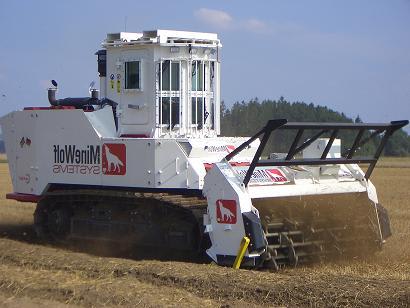
Mechanical clearance works by using a tracked vehicle outfitted with a rotating cylinder that has attached flails (metal weights) which with high centrifugal force pounds on the ground and the explosives to cause their destruction or detonation. Other systems use so-called rollers which are heavy metal drums which detonate the explosives. Both types are mostly used by armed forces and only work in certain scenarios (open fields or little vegetation).
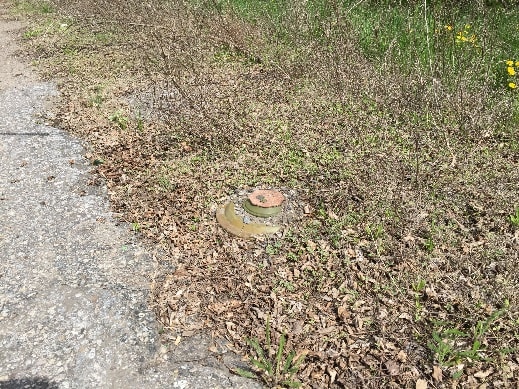
A good example for this method is the “Mine Wolf” (see image) built by the British company Pearson Engineering Ltd and used by the UN, and various militaries and organisations. The vehicle is rated to withstand mines of up to 15 kg of TNT or equivalent, so sufficient for all common anti-personnel mines and some anti-tank mines. A mine wolf can clear up to 25,000m²/day. I could not find any price for these machines and did not want to enquire with the companies. Normal excavators that are mass produced seem to cost between $750,000 and $1,000,000. Pearson on the other hand produces highly specialised and armoured vehicles so the assumption is that the cost per vehicle is somewhere between 10 and 20 million (very high uncertainty!).
Their limitations are around the type of contexts they can be used in. They are very useful on big open fields but not in forested spaces or ground that is not flat which limits their applicability. It is unclear how many fields exist that need to be cleared like this compared to more forested areas. Such vehicles might be very well suited to the type of terrain in Ukraine which experiences heavy contamination due to the ongoing war. Furthermore, it might be quite difficult to import this machinery into countries and get them to the places most affected by landmines as they might need to travel quite far which might be difficult.
If we assume that the above would not be an issue we can make the following calculations: If excavators can cover 25,000m²/day and cost around 20 million a piece (price + running costs) and hold for 10 years, clearing 1 hectare of land would cost 20 million / 10 years / 300 days = $6,666.66 per day for 25,000m² which are 2.5 hectares. Clearing 1 hectare therefore costs around $2,666.64. If one hectare has 10.98 UXO, the cost per landmine would come out to 242,86 and therefore the cost would be around $245.31per DALY (which could be a lot lower if the machinery cost less).
New technologies
There are also new technologies like tumbleweed detonators or drones used to survey inaccessible territory as well as self-driving vehicles. As all of these technologies are currently in development, I have not included an estimate of their effectiveness here but would summarise my thoughts as follows:
- Tumbleweed: is an interesting concept which is applicable to heavily contaminated flat land without vegetation. It only triggers ordinance with a pressure sensor. Other types with timers, radio frequency detonators or magnetic detonators and crucially, ammunition would not be detonated by this technique making it only applicable in the narrowest of applications.
- Drones: depending on their sensing equipment can and already are very useful for surveying. Yet, it does not help with diffusing and is a quite high tech technique for a context which usually suits more robust tools. Still, there are certainly possibilities worth exploring.
- Ground penetrating radar: Another technology used for UXO clearance (not applicable for anti-personnel mines and IEDs) is the detection with ground penetrating radar. Large arrays can be built to create an image of the soil and its contaminants. This method enables actors to survey large areas quickly. This method is used primarily in commercial settings before a construction or to identify contaminants in old military installations, humanitarian use cases are also possible.
- Self-driving vehicles: the mine wolf can already be used in a remote driving setting. Removing the personnel from the hazard is always a welcome possibility provided that the quality of work does not suffer because of it.
Victim assistance
Person is being hurt by an explosive -> person accesses emergency healthcare -> person survives -> person gets additional (medical, social or financial support) in the future -> lower deaths/DALYs and higher life satisfaction |
It seems like there are two points during which victim assistance can be helpful: (1) immediately after being in contact with an UXO, and (2) long term health and financial assistance.
It seems like people living in contexts with better healthcare systems would have better access to direct medical attention if they come into contact with an UXO. It is unlikely that it would be cost-effective to provide medical infrastructure just for the purpose of treating people affected by UXOs. Having said that, investment in medical infrastructure could be cost-effective because it could affect so many other diseases. Providing victims with prosthetic limbs is an integral part of victim assistance. This analysis is beyond the scope of this report.
In terms of the longer term victim assistance, it seems to soften the effects that the injury had on their life. It might help them to continue to work, or substitute the lost earnings they have and it might help them to remain mobile and participate in daily activities more. Both of these might be fairly expensive and only do a little to help people who are already affected.
Many humanitarian organisations have specific programmes for survivors to provide prosthetics, rehabilitation, and other services to help people re-enter into the workforce. Many also face stigma and exclusion due to their injury as well as the effect on their livelihoods.
In general, victim assistance seems fairly costly and only softens the effect of exposure once it already happens and does not do anything in regard to lost productivity because people don’t use fields or public infrastructure. Even with a perfect healthcare system it seems unlikely that people would take the risk of using public infrastructure and fields.
General remarks about interventions
It is important to be conscious of the fact that the most appropriate intervention is dependent on the type of contamination, terrain, vegetation, logistics and labour costs. Current implementing organisations have many decades of experience of choosing the most appropriate – and cost effective – method. This perspective was mirrored by the Head of Humanitarian Disarmament and Peacebuilding at the Danish Refugee Council who was contacted as part of the research.
It is important to note that it is highly dangerous to push for cost-cutting mechanisms in the clearance space to the detriment of quality for two reasons: (1) it increases the likelihood of accidents happening during the demining process, (2) locals gain confidence in the area being cleared and use it and might step on an overlooked landmine when they would otherwise not have used the space. This would erode the trust in all cleared areas and thus would be devastating for the confidence in the work. Pushing clearance organisations towards cost-effectiveness (if the intervention in itself is not cost-effective) can be dangerous!
Other factors may further complicate the cost-effectiveness calculation. The former chief of mine action for UNMAS Afghanistan, during an expert interview, has mentioned furthermore that the employment of several hundred or thousand deminers who are almost exclusively men in fighting age has a profound impact on the ability of insurgents to recruit them. If one provides about 9,000 men with a stable income in the territory of an insurgency it has far deeper effects than the effect of their work alone. Mine action thus gives them a skill, money and they are far less likely to join organisations such as the Taliban (this refers to the situation pre-Taliban takeover in 2021, but the principle very much remains). Weighing the impact of these very real knock-on effects is very challenging but shall not be forgotten when reviewing the cost-effectiveness of mine action. This impact is arguably smaller in peaceful places like Lao but it is relevant for others like Mali, South Sudan and so on.
Another thought to consider is that there might be more adverse effects on a community to lose a member due to literally being blown up compared to more ‘silent’ killers which take a few DALYs at the end of one's life or to something like HIV/AIDS. It seems reasonable to assume that the satisfaction of one's circumstances might be more affected by the presence of UXOs than of diseases – despite costing similar amounts of DALYs, or even less. We shall not forget that (unfortunately) humans are mostly not rational.
Funders
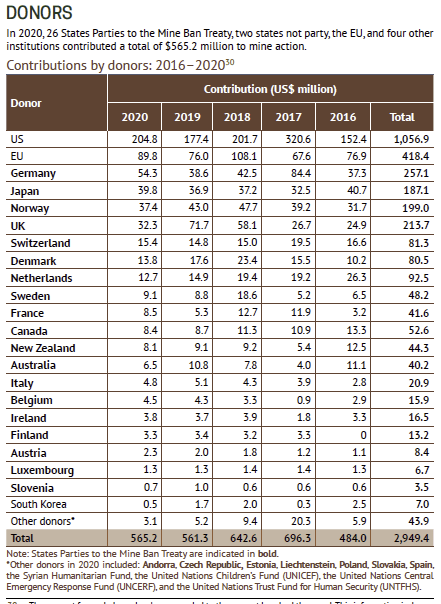
The funders of the mine action sector are quite consistent in their funding with relatively little change in funding over the years. Almost all funding comes from states and is distributed to the various mine action organisations. The biggest donors to mine action according to the 2020 Landmine Monitor are the United States, European Union, Germany, Japan, Norway, and the United Kingdom. The funds are used for operations by mine action organisations (most are non-profit, some are for profit contractors) as well as in some cases for their own military to engage in clearance.
The levels of mine and UXO contamination is usually very well known thus there is very little risk of neglected areas. The only reason for neglectedness would be that a place is inaccessible (government does not grant permission). Overall funders are not focused on one specific area, but rather are willing to follow needs assessments. One exception would be US funding to Lao and Cambodia – since the US directly caused the contamination and thus is the main funder for these counties.
Implementers
There most important implementing organisations are listed below:
Implementer Organisation | Comments | Annual budget (USD million) |
The HALO Trust | Biggest implementer, UK based 94 million HALO trust for 9980 hectares released (p.7) | 101.7 |
Mines Advisory Group | UK based | 90.3 |
UNMAS | UN Organization | 64.8 |
Danish Refugee Council | Mine Action is only one of their activities (~ ⅓) | 446.4 |
Norwegian People's Aid | Mine Action is only one of their activities | 109 (p. 31) |
Danish Church Aid | Mine Action is only one of their activities | 146 (p. 23) |
Apopo | Use rats to detect mines, Belgium based | 6.5 (p. 85) |
G4S | Commercial company, do also mine action | 6.9 (revenue) (p. 72) |
In general, the funds donated to UNMAS from the UN member states are directed towards implementation organisations which is why some of the UNMAS funds are counted double in the table above. They are the only Mine Action organisation which contracts other implementers. For a non-exhaustive list of further implementing organisations see here.
Most large demining organisations do not have a particular geographic focus but work where it is necessary and possible. Some organisations are focused on a specific way of detecting mines but that is mostly dependent on the form of contamination. Grants are usually made for a specific project focused on a region or specific site, unearmarked funding is often more helpful to organisations and can be used more effectively. Due to the high risks associated with working with explosives, implementing organisations are strict when it comes to safety precautions for their staff.
Many mine action organisations are based in the UK who are leaders in the field. Technical staff is often former military personnel thus being very effective and mission-oriented making negotiations quite streamlined and to the point. If one were to decide to fund mine action, I’d recommend contacting the implementers listed above and signal willingness to negotiate a grant. Based on my experience in the UN Mine Action Service Donor Relations department grants are usually between USD 200.000-5.000.000. Usually, the smaller the grant the less leverage one has, to set demands regarding reporting, location, type of clearance.
Other big actors are national so-called Mine Action Centres which are usually a body in the affected country which coordinates mine action efforts in a given place. Sudan, Bosnia and Herzegovina, Serbia, Sri Lanka and more all have one. Capacity building projects in which the national army is trained are also quite frequent, they mostly but not exclusively happen in bilateral agreements between states. National armies are often a substantial actor in clearance efforts.
Conclusions
Based on the research conducted I can conclude that the issue is:
- very important due to many reasons which are not properly captured with a simple analysis of DALYs,
- cost-effectiveness is not the primary consideration for mine action organisations (maybe with good reason),
- the current funding structure of mine action is not that compatible with EAs funding mechanisms, and
- prospects of starting an EA aligned mine action organisation would not be easy, cheap or be particularly welcomed by existing actors.
As discussed above, employing men of fighting age in areas with active insurgency groups has positive knock on effects beyond the work itself. Furthermore, the prioritisation of peoples on the ground might not be driven by a rational analysis but rather by the ‘dramatic image’ of explosions in their community.
In talks with experts the issue of bringing up cost-effectiveness did not lead to much understanding. Regardless, it is safe to assume that cost-effectiveness is important when planning a project in the sense of choosing the most appropriate approach for the task at hand.
The funding in mine action currently comes primarily from state grants where the donor has a lot of leverage deciding how the project is designed meaning that political considerations are a major factor. A donor like the UK is not really concerned if the project location is really the cheapest place to work and more with political considerations. Surely this is something which could be explicitly requested when approaching a mine action organisation regarding a project. With some explanation it seems reasonable to expect them to find the most cost effective place to work. But that would not necessarily ensure that the intervention itself would be more cost effective than other interventions.
Starting an EA aligned mine action organisation would theoretically be feasible but would require a lot of start-up capital and great financial resources. One would need to hire former military personnel to get technical competence. The starting salary for mine action international field staff is low at around USD 30-35 thousand, but the more experienced staff which would be needed to start something new is also more expensive. Furthermore, a lot of equipment and training is necessary, which are both relatively expensive. And lastly, to be allowed in a country one would need to project a seriousness to ensure that the national actors will allow for such projects. Due to the high stakes of dealing with explosives they are quite conservative and are eager to go with known organisations which have a track record. Due to these factors, I’d recommend writing a grant with provisions regarding cost-effectiveness rather than creating a new organisation.
These points lead to the conclusion for EA organisations not to invest in mine action and not to start a new organisation. In general, mine action is a fantastic field with incredibly brave individuals conducting work which eventually needs to be done, but the high cost of dealing with explosives and the dangers associated with it make the field too expensive for actors aiming to maximise their effectiveness.
If someone would be interested in investigating this further I would recommend the following starting points:
- Estimating the effects and effect size of removing landmines, IEDs and UXOs with greater confidence seems really important. Right now I have estimated around 0.99 DALYs per landmine removed but with very low confidence. Modelling this out in more detail seems vital.
- Writing detailed intervention reports for the more promising interventions that review the evidence base and model cost-effectiveness for these interventions in more detail.
- Evaluating the interventions through the work done by the organisations themselves instead of in the theoretical. There might be geographies and organisations that are doing really cost-effective work but are neglected by funding that is largely political.
- Investigating further variations of the interventions that I have looked at. For example, the question if there is a way to advocate for existing orgs/governments doing langmine work to focus on more effective strategies. The organisations might be interested in this as it frees up more of their budget.
I think there's a word or two missing here?
It'd probably also be helpful to spell out IEDs as 'improvised explosive devices' in the summary :)
Thanks for publishing this!