
All Comments

Four score and seven years ago our fathers brought forth on this continent, a new nation, conceived in Liberty, and dedicated to the proposition that all men are created equal.
Now we are engaged in a great civil war, testing whether that nation, or any nation so conceived and so dedicated, can long endure. We are met on a great battle-field of that war. We have come to dedicate a portion of that field, as a final resting place for those who here gave their lives that that nation might live. It is altogether fitting and proper that we should do this.
But, in...

You can now import posts directly from Google docs
Plus internal links to headers[1] will now be mapped over correctly. To import a doc, make sure it is public or shared with "[email protected]"[2], then use the widget on the new/edit post page:
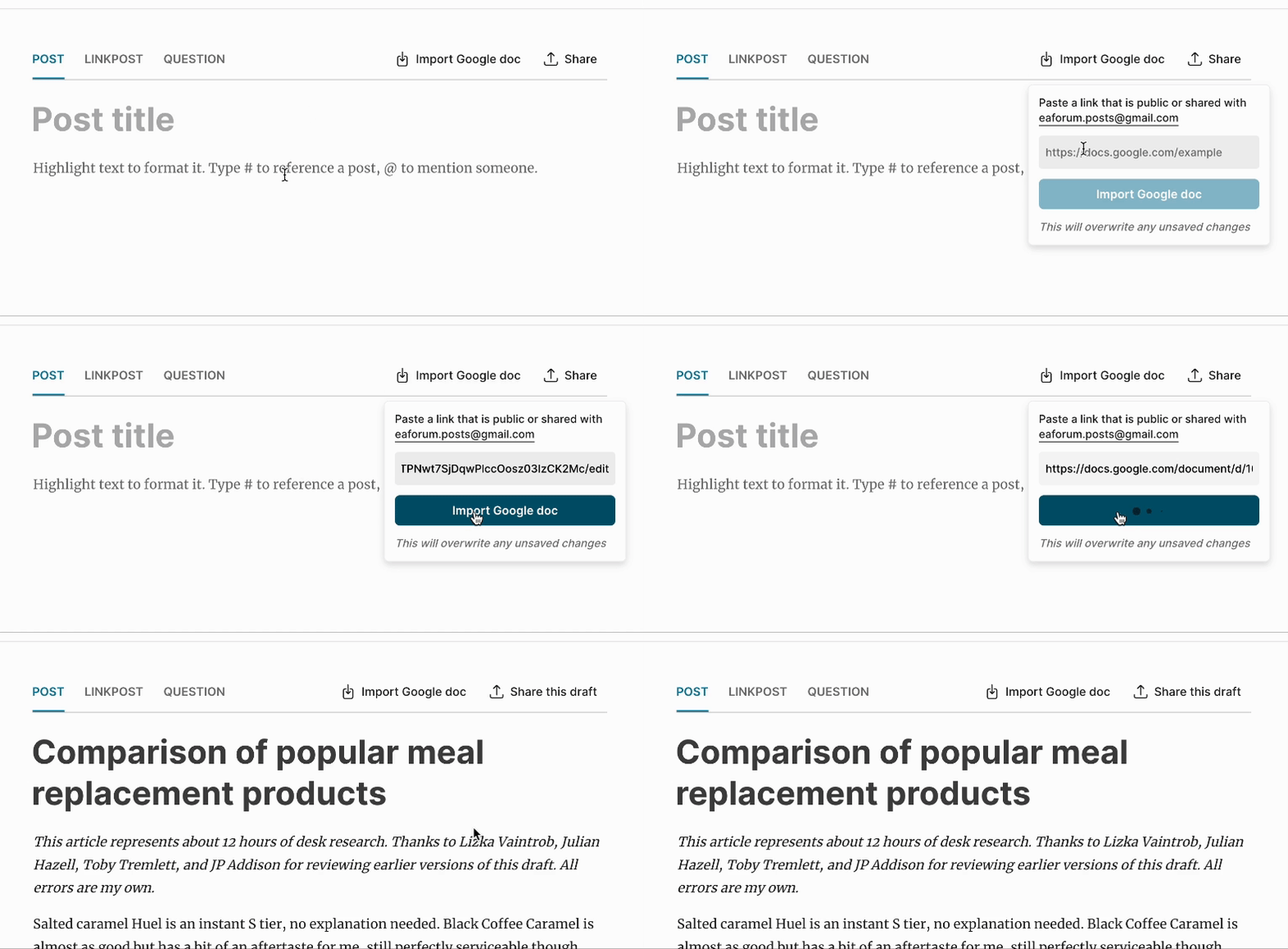
Importing a doc will create a new (permanently saved) version of the post, but will not publish it, so it's safe to import updates into posts that are already published. You will need to click the "Publish Changes" button to update the live post.
Everything that previously worked on copy-paste[3] will ...
PSA: You can now add buttons to posts and comments:
Click here to maximise utilityWe would love it if people started adding these to job opportunities to nudge people to apply. To add a button, select some text to make the toolbar appear and then click the "Insert button" icon (see below)
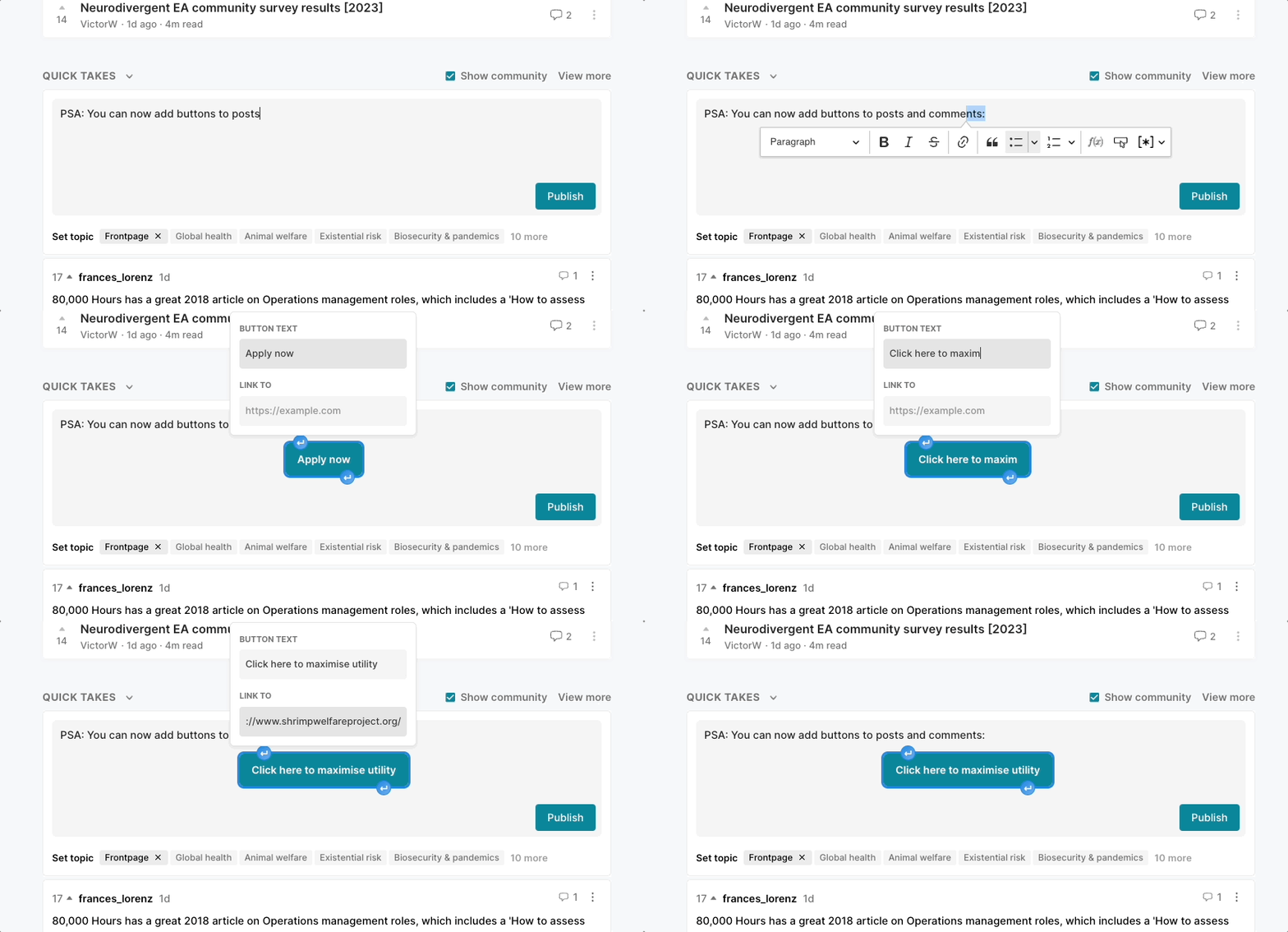
As always, feedback on the design/implementation is welcome.
I don't think we have much data on the effects of these [upskilling] grants several years out, as we have only been making them for 1-2 years, but I think that people often move into doing impactful work pretty quickly after their upskilling grant anyway.
I thought the first upskilling grant took place in early 2019?
Orpheus Lummis ($10,000): Upskilling in contemporary AI techniques, deep RL, and AI safety, before pursuing a ML PhD
Arguably the Lauren Lee grant also qualifies.
https://forum.effectivealtruism.org/posts/CJJDwgyqT4gXktq6g/long-term-future-fund-april-2019-grant-recommendations
Thank you for posting this, Joey. I think people too often talk about things like this in the abstract, not knowing the realities of the market. Two considerations I have when considering salary:
- Counterfactuals: Money, at the end of the day, is a limited resource. When considering the counterfactuals, I personally would feel unethical accepting a super high salary from CE, as I think the counterfactual of this money would be, e.g., one less high-impact organization being founded. In the early days, some of our charities started with just $25K-$50K grants;
Is there a single place one can search all grants? Ideally with these evaluations attached where relevant?
If not, would it be worth supporting either @Austin and @Rachel Weinberg or @Hamish Doodles or @vipulnaik to make one? Seems like having searchable public databases is worth the $5 -20k it would cost.
It might be helpful to add some useful reference classes here as I think it's often forgotten how unusual EA salaries are relative to other fields.
Average GDP of the world: £11,000
London's living wage: £21,800
Median full-time UK employees: £26,800
Average salary nonprofit jobs: £31,700
The average annual salary in London: £39,000
Average salary nonprofit London: £39,600
Average CE employee salary: £39,300
Entry-level EA job: £48,000
Average EA job: £80,000
I liked this!
I appreciated that for the claim I was most skeptical of: "There’s also the basic intuition that more people with new expertise working on a hard problem just seems better", my skepticism was anticipated and discussed.
For me one of the most important things is:
...Patch the gaps that others won’t cover
- E.g., if more academics start doing prosaic alignment work, then ‘big-if-true’ theoretical work may become more valuable, or high-quality work on digital sentience.
- There’s probably predictable ‘market failures’ in any discipline – work that isn
"My default interpretation is that someone doesn't value the role or my work very much."
I think this is a pretty unfortunate norm that some EAs have. In practice, it results in EAs by far prioritizing the best-funded areas instead of the most impactful ones. I think the reality is that offered salaries have far more to do with funding availability and perceived counterfactuals of funding. At the end of the day, AMF can absorb more money, and thus there is a higher bar for spending in global health than there is in areas without clear benchmarks.
I think this is a pretty simple and incorrect model. Job desirability is considered based on many traits (salary being one, but far from the only one), with different individuals weighing those traits at different levels of importance. If salary is the most important factor for a job, CE will basically never compete given the talent requirements; if autonomy or impact is the most important trait, it will compete even at very low levels of salary.
I am pretty skeptical that this would be the best way to increase diversity in EA per dollar. I talk to quite a number of incubation programs, both inside and outside of EA, and for most forms of diversity, I do not think that a low salary is the top barrier. I think that for age diversity, there is a case for this, but for country-level diversity, it might pull in the opposite direction. My soft sense is that both CE staff and the CE cohort are unusually diverse relative to the EA movement as a whole and similar EA incubation programs, despite having low salaries.
Also, a factual update: I think most numbers right now for founders are more in the 40-60k range.
Hi Sanjay, thanks for the comment!
sounds like a pretty great cherry on the cake
Indeed, I think part of the path to impact for far-UVC will be that adoption will hopefully be driven by, e.g., employers like Google equipping their offices with far-UVC lamps because they expect this to reduce the total number of sick days of their workers and therefore increase productivity + profits. Getting this type of evidence for efficacy would be great since it would be an excellent sales pitch to companies whose employees earn a lot, meaning sick days are costly. Ideal...
Thanks, Peter!
To your questions:
- I'm fairly confident (let's say 80%) that Metaculus has underestimated progress on benchmarks so far. This doesn't mean it will keep doing so in the future because (i) forecasters may have learned from this experience to be more bullish and/or (ii) AI progress might slow down. I wouldn't bet on (ii), but I expect (i) has already happened to some extent -- it has certainly happened to me!
- The other categories have fewer questions and some have special circumstances that make the evidence of bias much weaker in my view. Specifi
I really loved this! I have basically no knowledge of the underlying context, but I think this symmary gave me a feel for how detailed and complicated this is (reality has a lot of detail and a lot of societies for air conditioning engineers!), a bit of the actual science, as well as some of the players involved and their incentives.
It's helpful and interesting to look at what small scientific communities are like as analogues for EA research groups.
Thanks!
Are you thinking about this primarily in terms of actions that autonomous advanced AI systems will take for the sake of optimisation?
Hum... not sure. I feel like my claims are very weak and true even in future worlds without autonomous advanced AIs.
"One large driver of humanity's moral circle expansion/moral improvement has been technological progress which has reduced resource competition and allowed groups to expand concern for others' suffering without undermining themselves".
Agreed but this is more similar to argument (A) fleshed out in this foo...
Thanks Vasco! Perhaps a nitpick but suffering still doesn't seem to be the limiting factor per se, here. If farmed animals were philosophical zombies (i.e., were not sentient but still had the exact same needs), that wouldn't change the fact that one needs to keep them in conditions that are ok enough to be able to make a profit out of them. The limiting factor is their physical needs, not their suffering itself. Do you agree?
I think the distinction is important because it suggests that suffering itself appears as a limiting factor only insofar as it is strong evidence of physical needs that are not met. And while both strongly correlate in the present, I argue that we should expect this to change.
Do you think it might be a good idea to make brain simulations of subcortical areas (like the ventral tegmental area, periaqueductal gray, and others) that "produce" affects (good or bad experiences, like the 7 basic emotions described by Jaak Pankseep, homeostatic affects like hunger or sleepiness or food satiation, or sensory affects like physical pains or disgust) in order to make aligned AIs?
We want AIs that have the same values and goals that humans have. But humans seem to have different goals and values at times. We can differ so much that we have w...
Interesting, thanks Ben! I definitely agree that this is the crux.
I'm sympathetic to the claim that "this algorithm would be less efficient than quicksort" and that this claim is generalizable.[1] However, if true, I think it only implies that suffering is -- by default -- inefficient as a motivation for an algorithm.
Right after making my crux claim, I reference some of Tobias Baumann's (2022a, 2022b) work which gives some examples of how significant amounts of suffering may be instrumentally useful/required in cases such as scientific exp...
There are probably good proxies for climate effects though: i.e. reductions in more measurable stuff, so I think the situation is no that analogous to AI. And some global health and development stuff involves things where the outcome we actually care about is hard to measure: i.e. Deworming and it's possible positive effects on later earnings, and presumably well-being. We know deworming gets rid of worms, but the literature on the benefits of this is famously contentious.
Definitely - though I think mandatory reformulation is the best amongst the existing top solutions we recommend. It shows the largest effect size under the modelled parameters, but also it's probably less politically toxic - taxes are comparatively harder. We see this with climate too, where people favour quotas/quantitative limits over taxes even if the effects are literally identical.
Wow - this is a long post, and it's difficult for me to point out exact which bits I disagree with and which bits I agree with given it's structure. I'm honestly surprised it's so popular.
I also don't really understand the title. "Against much financial risk tolerance".
- The conclusions doesn't seem to support that
- I'm not sure it makes sense grammatically? "Against too much financial risk tolerance", "Against many arguments for financial risk tolerance"?
Starting with your conclusions:
...Justifying a riskier portfolio
- The “small fish in a big pond + idiosyncratic
Thank you for sharing these reflections, Asya! And for your service as the LTFF chair!
I feel confused about the difficulty of fund manager hiring. One source of confusion comes from the importance of expertise (/doing-good-direct-work), as you touch on in the post:
...Historically, we've had trouble hiring fund managers, especially in technical AI alignment, largely for the reasons mentioned above (people generally want to focus on their work). I think there's an extent to which I've contributed to our difficulty in hiring, in that I'm not sold that people doi
Thanks for the in-depth dive into Protect Our Future and their connections with the crypto world. It's fascinating how intertwined politics, crypto, and lobbying can be. The fact that a significant number of endorsed candidates have some link to pro-crypto sentiments is, for sure, something worth pondering. But then again, with the growing influence of digital currencies, it's becoming a hot topic for many politicians, irrespective of their financial backers. By the way, speaking of advancements in the tech world, I recently came across Quantum AI. It’s an...
I think the layout of this post is quite reader unfriendly.
I strongly suggest you start with a full summary rather than just an intro, and don't bury your conclusions midway between the post and some very long appendices which are unlikely to be very useful to 90% of readers.
As it is, anyone wishing to respond in depth would basically have to do the work of summarizing the post themselves, which increases the friction on feedback.
Thank you for your response. I find this piece of the response interesting:
"we want to be mindful of not underfunding projects or leaving grantees with deals they would rather turn down but feel uncomfortable doing so due to grantmaker-grantee power imbalances."
As someone on the grantee side of the equation (though I don't apply to this particular fund), I would much prefer an under-funded response of 30% of initial budget request rather than a rejection which is effectively an offer of 0% of the request. But I have pretty thick skin.
I think what I am aski...
The age of dankness in effective altruism is upon us. It's unstoppable. I don't mean this as the go-to administrator of the Dank EA Memes Facebook group, or as one of the more reputed online memelords/shitposters in the EA movement.
I don't just mean that as someone other effective altruists turn to for answers in the face of the onslaught of dank memes becoming a primary vector/medium shaping public perception of EA, both within and outside of the effective altruism community itself, for better or worse. I emphasize this as the go-to person other eff...
Thanks!
I don't know what this means:
Career Stage: Our interest lies in assisting grantees who are at the beginning of their careers, are contemplating a career shift towards an area of higher impact, or have accumulated several years of experience in their respective fields.
That sounds like everyone.
For years now, much ink has been spilled about the promise and peril of the portents, for effective altruism, of dank memes. Many have singled me out as the person best suited to speak to this controversy. I've heard, listened, and taken all such sentiments to heart. This is the year I've opted to finally to complete a full-spectrum analysis of the role of dank memes as a primary form of outreach and community-building.
This won't be a set of shitposts on other social media websites. This will be a sober evaluation of dank EA memes, composed of at least one...
We don't have anything public, but we are conducting some retrospective evaluations, which we expect to publish eventually which will look at upskilling grants in particular (though I don't know the timeline for publication right now).
Internally we have taken some lightweight measures to assess the value of upskilling grants and think that they are often pretty useful for accelerating people and getting people to do impactful work in or outside of the specific area they did their upskilling project in - though we hope to have more concrete and sharable dat...
kfjpdsjfodsfjiodfjds