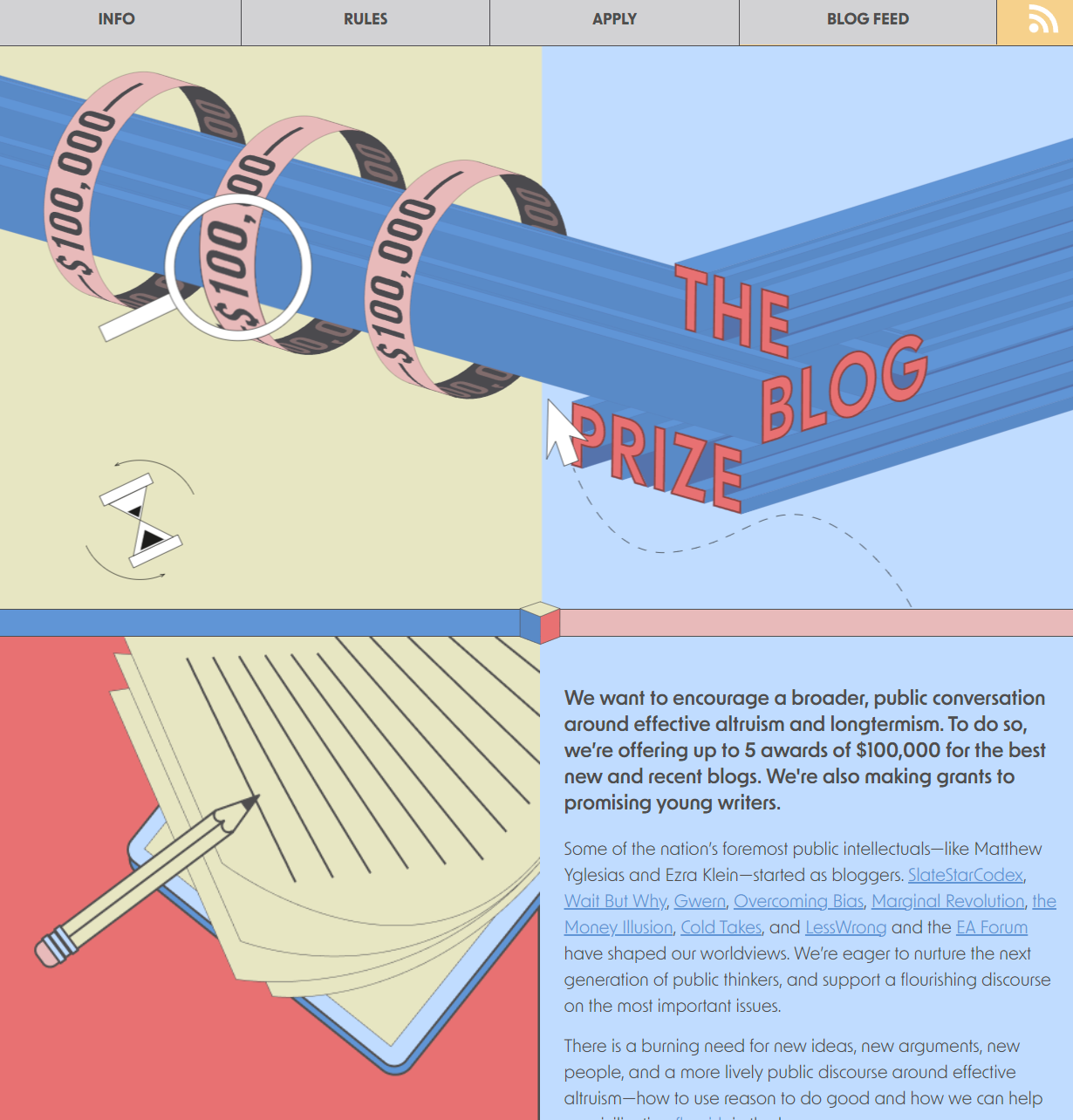
We want to encourage a broader, public conversation around effective altruism and longtermism. To that end, we’re offering up to 5 awards of $100,000 each for the best new and recent blogs. We’re also making grants to promising young writers in the community.
You can learn more about the project and get on our radar here.
Why does this matter?
Top-of-funnel community growth in EA is slower than it could and should be. At the same time, EA is relatively underrepresented in intellectual discourse compared to newer and smaller movements like Progress Studies. EA is producing a ton of thoughtful writing, but the majority takes place in internal discussions and private documents. For some discussions, this would be the only sensible way to have them. But having other discussions in public should help to raise the salience of EA in the broader discourse and bring more people in. It could also help spark new ideas.
Further, we think EA needs more strong writers who can share key ideas in prestigious and popular venues — to persuade people to work on the most pressing issues of our time and to advance our thinking about them. We want to incentivize EAs to develop those skills.
What’s the plan?
We want to jumpstart these ambitions with the Blog Prize. Over the course of 2022, we want to find the very best new blogs exploring themes related to effective altruism and longtermism. Up to 5 winning bloggers will receive a prize of $100,000 each. (We were inspired by Tyler Cowen’s “Liberalism 2.0” blog prize). You can read more about our rules and guidelines on our website.
The judging panel for the blog prize is me (Nick Whitaker), Leopold Aschenbrenner, Avital Balwit, and Fin Moorhouse. Most blogs will be considered via our self-nomination form, but please feel free to send us recommendations.
What next?
We hope this can be a first step towards a more ambitious effort to support an ecosystem of public-facing writing for EA and longtermism. We believe that EA blogs could soon make up a major part of the general blogosphere, finding audiences (and potential EAs) we wouldn’t have found otherwise. Hopefully, we will also inspire the writing of foundational blog posts and posts that evolve into great projects.
To help potential bloggers, we’ve compiled a “How to start a blog” guide. We’re also offering mentorship on writing and editorial strategy to bloggers amid our private Slack community of bloggers. Self-nominate your blog on our website if you’d like to join. We have fostered a lively community for discussion, cross-promotion, and peer-to-peer feedback. Eventually, we hope to offer bloggers seminars from established EA writers.
While this is our first big announcement, stay tuned for future plans and follow ongoing efforts from Effective Ideas to build and foster a written media ecosystem for EA. Watch this space.
This project is supported by FTX Future Fund and Longview Philanthropy.
Any thoughts about making some of this discussion available to bloggers so they can popularize it? Asking bloggers unconnected to the EA network to reinvent or equal the level of discourse that the top people have among themselves sounds much harder than figuring out a way to get the originals to the public.
I agree that this would be very valuable. I work at an EA org and even I miss out on a lot of discussions that happen between top people, on googledocs or over lunch. Things must be much worse for people not at EA orgs.
It would be useful if some of the top people could share why they prefer not to make these discussions public. I would guess that one reason is that people don't want arguments which they haven't backed up in formal ways to be classed as "the official view of EA leaders". Creating a forum for posts with shakier epistemic status seems valuable
I imagine often context is missing that would be effortful to add, e.g.
In some cases the discussions contain plausibly sensitive info, eg about individual people or about stuff that might cause problems when public.
The first two issues are the whole point of laundering your opinions through bloggers.
I don't mean the bloggers should post the documents publicly, or even a play-by-play of the documents ("First Will MacAskill said, then Peter Singer said...") . I mean the bloggers should read the documents, understand the arguments, and post the key points/conclusions, perhaps with a "thanks to some anonymous people who helped me develop these ideas".
I agree the last issue is important, but this could be solved by good channels of communication and explanation about what should/shouldn't be posted.
Perhaps an enterprising blogger could start an interview-format blog, where they interview EA authors of those "internal discussions and private documents" and ask them to elucidate their ideas in a way suitable for a general audience. I think that would make for a pretty neat and high-value blog!